Friday, 14 May 2021

Wolves wood & Groton Wood - 12/5/2021


Like green hands reaching for the sky


Away from the coast, the hinterland of Suffolk is very rural, with few towns or settlements, but also one in which there are few designated nature reserves. Rolling field after rolling field offer a formidable barrier in the way to look for birds, like looking for a needle in a haystack, I could spend a lifetime searching all the footpaths of this rural land, and never see what I set out to see. It can be quite daunting looking for birds in the endless landscape. So it was that today I discovered some new countryside, just a small amount, but enough, out Hadleigh way. Lying west of Ipswich, around that small town are a couple of pockets of ancient woodland, Wolves Wood and Groton Wood, which offer a place to be able to contemplate nature, in the reassuring confines of a nature reserve. 


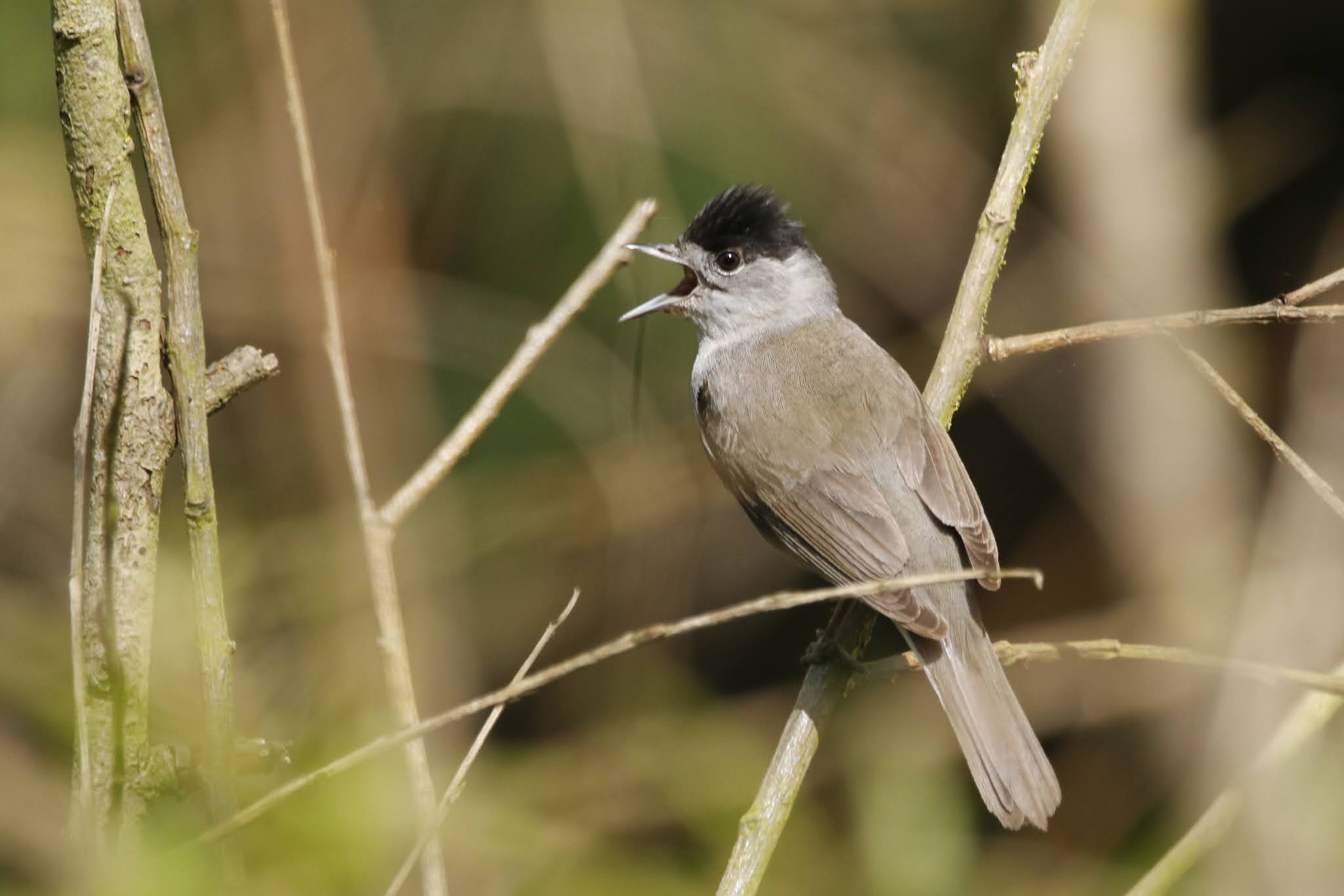
Male BLCAKCAP inhabit the thick underlayer of the forests

As well as visiting those reserves I also planned to do a recce as part of the national Turtle Dove Survey. I was given a transect to monitor for this species, in an area between Ipswich and Hadleigh, around a village called Hintlesham. Today, being too early in the season for turtle doves, I just used it as a recon mission to have a look at the site I would be monitoring. Basically it was a golf course with not much habitat so it doesn't look too promising for the species. The turtle dove at the moment is hemorrhaging its population, with numbers plummeting year on year, mainly due to habitat destruction here and hunting on its migration routes. In the not too distant past it was fairly common in Suffolk, but nowadays it is quite rare, locally centred on the last remnants of suitable habitat. In a few weeks time I shall return, do the survey and upload my results to help gain some information on the species.


What an old coppiced wood looks like, each coppiced tree grows back even thicker

After that I went to have a look at the woods.

Wolves Wood

Along the Hadleigh road, Wolves Wood is a sizeable chunk of ancient woodland owned by the RSPB. Like a lot of ancient woodland it has a large amount of coppicing, a rural industry that provided charcoal for fires in olden times. Coppicing is basically the ancient art of cutting trees back on yearly cycles, with the trees growing back, but even thicker, ready to be cut down again. This opens the woods up making sure light rains down from the canopy, making the wood more beneficial to light loving wildlife. Along side the coppice, certain trees have been allowed to mature, growing taller than the coppice, reaching for the sky, again providing a different source of habitat for more wildlife. As well as this the forest provides sunny glades, rides and ponds, a complex interplay of different habitats that make up an ancient forest, a million miles away from those lifeless conifer plantations which are so much more common.


A path through the woods gloriously overgrown

At this time of year birdsong is at its peak, and it was good just to listen to the music being conducted within the forest. There is so much going on with this cacophony of sound that even my trained ear can be overwhelmed. Nothing unusual was about but even the most common of birds can have a beautiful voice. My favourite is the SONG THRUSH, a bird that belts out its song from a bushy thicket, a song that changes every two beats, a song so bewildering, so unique, that it takes you onto a sonic journey. Its just so pleasant to just stand and listen for a while just embracing the forest's sounds, a sound that connects me back with an ancient self, before civilisation.


Last winter's coppice, with the odd tree left to grow tall

At this time of year our woodlands are aglow with bluebells. However due to certain reasons Wolves and Groton Woods do not have this display. This is because the blue carpet of bluebells is something artificial, the result of an exploding population of deer. Natural, ancient woods have a hierarchy of thick layers from the canopy down, but as deer browse the forests they eat everything in their reach, resulting in empty layers of nothing beneath the canopy. Bluebells survive because they are toxic to deer and so end up being the only plant left to flower. In Wolves and Groton Woods, deer are controlled, and fences are put round the coppicing to protect from browsing, which results in a thick understory of young trees and bushes, which means the understorey is dominated by brambles. By controlled I mean culled, which again is a massive ethical question. As usual its the result of man meddling in the environment. Yes its good that deer populations are at an historic high, but its bad that they put such a strain on the environment.


PEACOCK BUTTERFLY are the most common in the forest

Groton Wood

This Suffolk Wildlife Trust reserve is really out in the countryside, along single track roads through lost villages and acres of rolling countryside. This was my first visit to the site, I thought I might dare to visit being in the area and all. In many ways its superficially like Wolves Wood, both being excellently managed pockets of ancient woodland. But comparing these vast reservoirs of life is a folly as they are just so different. There are acres of coppice, rides aerate through the trees, and ponds and glades open up the canopy. It was in one glade where I found the only stand of naturally occurring BLUEBELLS, a carpet of blue beauty like rain drops appearing amongst the grass. 


A glade covered in BLUEBELLS

Its amazing to think that parts of Groton Wood has been tree covered since the ice age, thousands and thousands of years of tree cover, an area that has withstood the ravages time. These woods are so full of life compared to the surrounding fields, an area that embraces nature rather than fights it. Imagine being a giant, being able to rip the woods from the land and then to upend it and shake it, imagine all the life that would fall out, all the animals, birds and insects. Just this small wood on its own is breathtaking.


A fallen tree

These ancient woodlands are like a wildlife version of Stonehenge and are just as ancient, just as precious, and under the various wildlife charities are better protected. They are hidden gems, I barely saw anyone in either wood, great places in which to revel in nature, to breath in their timeless qualities. And like any dynamic living system the wood is always on the move, changing constantly through the seasons. The only drawback, however is that they sit there on their own, all alone in a countryside, surrounded by arable fields, isolated from one another. Not matter how big they seem, these relics of woodland are no bigger than an arable field, mere pin pricks in the countryside. We need more, and we need them to be connected, just so everyone can experience their majesty and have space to immerse.

Friday, 7 May 2021

Hen Reedbeds and Tinker's Marsh - 3/5/2021

WHIMBREL, notice the eye stripes and bent bill which distinguish it from the curlew


Vast acres of mud form the Blythe estuary, a low lying land with vast horizons. This forms part of the Suffolk Coast nature reserve, a huge protected area that like Minsmere encompasses a large variety of different habitats, the sort of reserve unique to Suffolk. This range of land forms attract a lot of birds, and this nature reserve is one of Suffolk's best. Its more low key than Minsmere, traversed only by footpaths, you would only know it to be a nature reserve if you had prior info. Its been a long time since I have visited either site, Hen Reedbeeds and Tinker's Marsh, so its good to finally catch up with them. Late April, Spring migration should be at its peak, but with the freak weather passing onto May, things were a bit different. The day suffered from a strong westerly wind, which made walking the exposed river walls a bit of a chore, as well as keeping all the birds low. At this time of year the best winds for spring migration is the exact opposite to today, a south easterly wind guiding birds from the continent.

Hen Reedbeds

On the north side of the estuary, Hen Reedbeds is a recreated habitat, where poor pastureland has been allowed to become overgrown with reeds. This in turn makes it attractive to rare birds of which the Suffolk Coast is a national stronghold. The site was created and is owned by Suffolk Wildlife Trust, who do a great job looking after the site.


WHITETHROAT by the viewing platform

Part of the reserve is a river valley overlooked by a viewing platform, with no access. Immediately in front of the platform a family of WHITETHROAT were raising a family, the birds busy coming in with food and and out from crap from the nest. Out in the distant marshes several MARSH HARRIERS were out gliding over the reedbeds, as you would expect. A BITTERN was briefly heard booming, the strange and distinctive song of a little brown heron which is the songbook for this kind of habitat. Both the marsh harrier and the bittern are the specialties of reedbeds that are attracted to reserves like Hen Reedbeds, found in no other habitat. Another, though commoner, reedbed specialist, REED WARBLERS were singing everywhere in large numbers, males seeking out a mate and to defend their territories. This is one of our later returning summer visitors, coming in at the end of April.


OYSTERCATCHER

Half of the reserve is accessible, where the main path follows the river wall, with the estuary on one side and with views of the reeds on the other. At the time I was there, the tide was out and WADERS were few. The estuary was a narrow channel at this point before opening up into a vast area of mud just a short walk down. A COMMON SANDPIPER was on the river wall and a WHIMBREL was on the mud. Later more WHIMBREL were seen, this time eight of them in flight over me.


One of the meres on the reserve

The reed lakes were the haunt of small numbers of MALLARD, GADWALL, TEAL and SHELDUCK. At this time of year duck numbers are low as its the nesting season, when ducks nest at low densities.

From the reserev I walked up to a nearby farm where I enjoyed coffee and some giant doorstop scones.

Tinker's Marsh

Tinker's Marsh, is one of my favourite place names in Suffolk. It evokes a countryside that has long been lost, when Suffolk was much more remote and wild, when there was probably a lot more birds. Although being located next to the honeypot site of Walberswick, Tinkers Marsh feels remote and wild, not many people traverse the river wall here. Its a low lying area of grazing marsh that hugs the sides of the estuary, with good stands of reeds. It lies right across the estuary from Hen Reedbeds, on the south side and you can see the hides from the river wall at Tinker's.


Southwold Harbour

I parked at Walberswick church, around midday, and started walking through the gorse covered common land, continued along the old railway line, before hitting the river wall, where close to Walberswick the estuary is a narrow channel. The tide was rising as I turned up with the mud around Southwold Harbour covered by the tide. Birding was quiet in the area, the odd duck or a LAPWING on territory seeing off a passing crow. OYSTERCATCHERS were about, this black and white bird is very noisy, flying around calling out as a pair. They are numerous breeders around this estuary. Another characteristic bird of the estuary, the REDSHANK, was only present in small numbers, its haunting call giving it the name "sentinel of the marshes".


Tinker's Cottage, a derelict building on the edge of the marsh

After some walking, one of the pools finally held some birds. Two male PINTAIL, two TEAL and loafing GULLS were present here, the pintail being interesting as they are very rare nesting birds, they don't often get hang around so late in the season. Towards the end of Tinker's Marsh the estuary widens out to a vast sea of mud. Being May numbers of WADERS were low but there was still a small variety about. Most numerous were the DUNLIN, with several small flocks, the birds numbering around a hundred in total. At this time of year the birds are in summer plumage, with a golden brown upper body and a nice black underbelly, different to their grey and white winter plumage. With one flock were four GREY PLOVER and three GREENSHANK. The plovers weren't yet in summer plumage, where they have a distinctive black chest and silver upperparts. Three BLACKWITS were around as well as a small flock of AVOCET. 


Mute Swan, common on all the pools

Of the pair of MARSH HARRIERS present on Tinker's Marsh, the male had red tags stuck to its wing, although I didn't get the number. This is a form of ringing which identifies the bird and the travails it goes through, I guess for scientific purposes because although common in Suffolk they are still a nationally rare breeding bird.

On one of the saltmarsh islands on the estuary, there was a small colony of BALCK HEADED GULLS with a few MED GULLS amongst them. This colony is a fraction of the size it was around fifteen years ago, when thousands of birds crammed into the entire island, making it an awesome sight. The reasons for the decline are probably natural, and may increase again, the habitat is still there.


Little jetty on the estuary

The walk back through the heaths resulted in a HOBBY over the trees, swooping through some arable land where it put a flock of pigeons to flight, before disappearing. This is a nice record, this marsh falcon is a late arriver, usually turning up around mid May, I haven't seen them in this area before.

After that it was a brief walk back to the car.

Blytheburgh

Just off the A12, the village of Blytheburgh sits on the edge of the Blythe estuary. Here the mud is vast and wild, although the tide was high at this point, a great expanse of water. Numbers of WADERS were small, mainly the same as the ones seen above. More WHIMBREL were about, it seems I have caught them on their main migration time, with numbers easily in double figures. Whimbrel are like smaller curlews, however they are slightly different, with a bent bill rather than a curved one, a black eye stripe and a different call. They are a birdwatchers bird, proving a challenge to identify, and provide a test of field craft.


Vast horizons and lots of mud

In the end it was an interesting day out on the Blythe, however with few birds about. Although the birds weren't in large numbers there was still a good variety about, and I saw a lot of species. As always with such places, the landscape was gentle but stunning providing great views when there weren't any birds. Its amazing that such areas of wilderness in lowland England still exist, one under so much pressure from development and the tourist hordes, and the financial starvation of the reserves managers, Natural England. These are the last strongholds of many birds, ones starved out of the surrounding countryside and it is essential such places are well looked after.

Friday, 30 April 2021

The River Gipping - 30/4/2021

SWAN nesting Riverside Farm Pit

Its not often we get such a dry, cold April. Another month like this that comes to mind was the Spring of '96 back in my young boy days, when a visit to Ouse Washes saw dust storms blowing in the Fens. As a result of this old, dry weather, this has been a very poor month as Aprils go, with Spring migration, usually a flood at this time, barley a drip. So it was that it was a very poor showing as I traversed the birding sites along the Gipping. The main interest, birdwise today were the young birds which the early nesters are starting to fledge, as there wasn't much migration to speak of.

Pipps Ford

The centrepoint of all birdwatching in the valley, is the Pipps Ford area which has the right combination of habitats to attract interesting birds. PippsFord is a combination of finished and active quarry, two further small lakes, rough grassland and woodland. At this time of year the area encourages waterbirds to nest, and there was a decent number here today.


Finished Quarry

First point of call is the former quarry, a small excavated area now flooded with water. A few waterfowl were about, some nesters, some with chicks. Most interesting of all was a GADWALL brood of 2 with a further pair, plus two broods of COOT with another nesting, and a GREYLAG brood of 5. LITTLE GREBES were also about, but I couldn't find any waders along the muddy edges, which can be a good place for them. A small passage of HOUSE MARTINS were hawking insects over the water a whizz of little birds with their distinctive white rumps, this is my first record for the year, it being a very slow migration year.


After that part of the quarry the path hits the river Gipping and winds its way up to Riverside Farm Pit. A small area of water, grazed by horses on its shores, a SWAN pair had built a gigantic nest amongst the bulrushes, and a pair of COOT and a male GADWALL were also present. To go further, the path winds back on itself and then up to Pippins Lake. Another small lake, fringed by trees there had been a drop off in wildfowl since my last visit with just two male GADWALL and a male TUFTED DUCK, with one COOT and SWAN apiece. The number of single male GADWALL around the area may mean there are females nesting somewhere out of sight, a few nest here every year. Next to Pippins Lake a GARDEN WARBELR was singing from a bush beneath the trees, my first of the Spring, similar in song to the much commoner BLACKCAP, which was also present in large numbers.


Digger on the Active Quarry

Just above Pippins Lake is the Active Quarry, a busy world of diggers, bulldozers and lorries, which made it a not particularly nice area to birdwatch, especially when a passing lorry kicks up a lot of sand in your face. Its a large, steep sided lake with islands and no vegetation, that changes form day to day, even more so over the years. A GREAT CRESTED GREBE was nesting on one of the islands and two male GADWALL were about. Unfortunately there were no waders about, usually this is a good area, and of further interest was a GREY WAGTAIL.


Barham Pits

South down the River Gipping, Barham Pits isn't the best place for looking for birds, being a couple of fishing lakes of not much interest. As I always say about this site, the current owners have really gutted the area, destroying most of the bird habitat over the recent years, which has made the place even worse. On Barham Pit A, a deep sided pit which has had its reedbed destroyed, a KINGFISHER was present, whilst a SEDGE WARBLER was singing from the last of the lakeside reeds.


Nesting GREAT CRESTED GREBE

On Barham Pit B, a large and wooded lake, GREAT CRESTED GREBES were having a boom time, with two young having hatched, another bird nesting. With a further pair hanging around, the pits along the river Gipping are a Suffolk stronghold for this species. COOTS had hatched three young and there were three GREYLAG GOSLINGS hanging around with the large number of geese.

Papermill Reedbeds

Another quiet area, the riverside meadows of Papermill is where I spent a quick visit, this site is further south along the river from the other areas. Cows have been reintroduced to the river side meadows including that annoying "bull in field" which farmers love putting along footpaths. Of note were two singing REED BUNTINGS singing from the reedbed area, although not many other birds, none of the reedbed warblers were back yet.


Along the lush river Gipping

I met a guy testing the river here for water quality with this little gadget suspended in the water, connected to a computer device. He told me that although the river looks clear and healthy, has lots of vegetation and fish and other wildlife, the water is actually suffering from nitrate runoff from surrounding farms. This destroys the life of the river right down to the micro level.


Male BLACKCAP, one of the commonest warblers, there's usually a bird singing from most bushes

A pretty poor showing from the river Gipping today. Being a local patch for me, there is an onus on me to bird the area no matter what. I would love to have Minsmere on my doorstep, but I have to live near civilisation, so have accept that the best place I can go to is the river Gipping. As I often say, birdwatching non nature reserves can be a lottery, as you don't know what the landowner has done to the site they are in charge of. Birds are fairly resilient and can be found in most places, but even the most hardy of wildlife is struggling in this industrialised countryside.


Tuesday, 27 April 2021

Breeding Bird Survey - 21/4/2021

The track led through fields of rape

Every Spring the British Trust for Ornithology (BTO) conducts the Breeding Bird Survey (BBS) in which volunteers walk a transect recording the birds they see. This is done twice, four weeks apart between mid-April and early June, involving going out to a preset area of countryside. It charts the population trends of certain species and has been going for many years. This is the biggest survey for breeding birds and is an honour for birders to take part in. For a set of reasons this is the first time I have done the survey, which made it doubly important.

My transect was a long farm track that cut its way through a landscape of rape fields, with a heavily cropped hedge running alongside. The transect was just off the A1120, opposite Stonham Barns, home of the hawk and owl sanctuary, a quite area of unassuming countryside in mid-Suffolk. As the survey had to be done very early in the morning, I got there for six in the morning, I only really had one day off to do it, having to go work and stuff. Unfortunately on the day I chose to do the survey it was extremely foggy, with very little visibility. Part of the survey entails recording the birds in the distance, out to either side of the recorder as they walk along the transect. Then the walker records all the birds they see and hear as they walk down. Unfortunately I was hampered by the mist and I couldn't see into the distance, which kind of bummed out a lot of the survey. The fog graciously cleared up literally just after I finished the survey as things annoyingly do.


COWSLIPS were flowering in profusion on the hedgerow banks

As you would expect from the habitat I described, an area of intensive farmland, the number of birds were low. My first WHITETHROAT of the Spring was recorded, some YELLOWHAMMERS and LINNETS were about, and lots of singing SKYLARKS. The most surprising sighting was a flock of 14 REDWING flying over. The cold Spring has kept a lot of winter birds hanging around later, but I didn't expect to see this winter thrush on a late April day. Even stranger was another flock, this time of 40 FIELDFARE, seen just outside of the survey area. Also around, also outside, were BUZZARDS and KESTRELS, usual birds of the countryside now.

Even further outside of the survey area large numbers of COWSLIPS and PRIMROSES had flowered along the hedgerow banks, that grew beside the footpath, providing a splash of yellow in the canvas of green, intensive farmland. Also two ROE DEER were seen, briefly running across the path I was walking, seen and gone in a flash. 

As you would expect with a morning's birdwatching through intensive farmland, there wasn't a lot of birds to see. But still when you take part in a survey you really want to see as many birds as possible to show  just how good you've been. But no matter how good a birdwatcher you are, if there aren't the birds to see there's nothing to record. And its like that pretty much throughout the countryside, silent places devoid of wildlife. And things are only getting worse.


Friday, 23 April 2021

IBERIAN CHIFFCHAFF, Foxhall Heath, Ipswich - 23/4/21


An extreme rarity, a newly created species, unique to just one area of Europe, an IBERIAN CHIFFCHAFF showed up on the outskirts of Ipswich, when it should be in Spain. This was such an unusual record and being one that was nearly on my doorstep, I just had to go look for it. It had been present for a couple of days but it was only today I had the chance to catch up with it. I don't normally twitch, the part of birding that chases rare birds, but I couldn't resist the urge and went over to Eastern Ipswich to bag a lifer.


The IBERIAN CHIFFCHAFF has a slightly different plumage from the commoner birds.

This is one of those birds that get people annoyed with twitchers, its one of those little brown jobs, almost identical to our own chiffchaff, separated only by a slightly different song. CHIFFCHAFFS are very common birds and there were lots of them singing throughout the woodlands. The common chifchaff has a monotonous 'chiff-chaff' song likes its name, however the Iberian starts off with a 'chiff-chaff' but ends with a trilling sound. Yep, that's all it takes to differentiate the two species. It has only recently been separated from our chiffchaff into two separate species, by scientists, which means it never got any attention before that. Yes, the bird doesn't quite get the juices flowing like an eagle or a crane, but it had its own charm, and it was a real test of bird watching skill to tell it apart from the more local birds. It had a more distinct eye stripe and a white chest compared to the common chiffchaff, but nothing that stood out.


The bird stayed in the tree canopy, like most chiffchaffs, singing its heart out

With the advent of technology, birding has been changed forever. On the internet every record of every bird has been been published, so its easy to know what's about before you go anywhere. Also I was able to play a youtube video, on my phone, of the bird in song, next to the real singing bird just so I could confirm it was an Iberian Chiffchaff I was listening to. A part of me disapproves, its not proper fieldcraft, but another part me feels the exact opposite, of how easy it makes birding. A few other birders were present, but not many considering the bird's rarity and closeness to Ipswich. It was quite good to meet local birders and to get their lowdown on the local area, and I felt important telling newly arrived birders where the chiffchaff was - walk to the stadium, take the main track down and its in that area, where its singing its heart out.


Peekaboo

The IBERIAN CHIFFCHAFF took up brief residence at Foxhall Heath on the outskirts of Ipswich. Despite living in Ipswich for a long time this was my first visit, because I live on the other side of the town, and I had no reason to go here before. Its part of the few remnants of the Sandlings heaths left in the area, an area of heathland which used to spread all along the |Suffolk coast. Its overgrown with secondary woodland, mainly silver birch, and being next to a housing estate was full of joggers and dog walkers, many of whom were curious with what me as a birdwatcher was up to. It was quite difficult to explain what I was doing, staring up at a bird in a tree taking pictures with my big old camera. At this time of year the woods were full of bird song and surprisingly there were quite a lot of birds about. On the edge of the heath was Mill Stream Local Nature reserve, a lovely area of marsh, ponds and thick scrub, in a little river valley, where, of course, the CETTI'S WARBLER could be heard booming out. 


JAYS are quite difficult to photograph being quite nervy birds, but having such a beautiful plumage are well worth the effort

Its always good to get a lifer, even if it wasn't the most exciting of birds to see. This was a  birdwatcher's bird, one that was a real test of fieldcraft one that wasn't a given, just to turn up and tick off, but one that took some effort to identify. Twitches are quite sociable for birdwatchers, a hobby not really for those who like company, so its good to catch up with other birders and to be able to talk about birds with people, the only thing I know about, and which I can't do with normal, non-birding people. Birdwatching is such a nice hobby and days like these are why I like it so much, which makes me sad that tomorrow I go back to work.

Tuesday, 20 April 2021

Minsmere - 16/4/2021

GREY HERON at Island Mere

At last, after a winter spent in lockdown, with only local visits to local sites possible, the world has finally opened up. As I haven't visited Minsmere since early December I was really missing the place and the birds that inhabit it. For this reason I decided to make Minsmere my first point of call when it reopened. April is a great time for birds with Spring migration really gearing up up as millions of birds are on the move, as they take the journey from their wintering grounds to look for a place to nest in their breeding grounds. At this time of year anything is possible, and there is no guarantee what will turn up.


Male STONECHAT on the beach

This has been a strange Spring so far. Record temperatures in March led to an early influx in summer migrants to out shore, yet the cold northerly winds in April has changed this, with spring migration really slowing down. Today at Minsmere where a dearth of migrants was noticeable it was fairly uneventful. However  there are always birds at Minsmere and on a beautiful warm, sunny day it was a good time to be out birdwatching.


The Scrape is an area of shallow water with islands that attracts many birds to nest


Today wasn't a classic spring day at Minsmere, with nothing out of the ordinary to see. One of the joys of this time of year is the breeding birds, which inhabit Minsmere in mind boggling numbers. On the Scrape, birds jam pack into the many islands, thousands of birds nesting and territorial marking, cheek by jowl with each other, creating a cacophony of sounds. Unfortunately, due to the coronavirus keeping us in semi lockdown, the hides were closed so views of the Scrape were reduced to scoping from the dune tops, although the Public Viewpoint was open which gave views of South Scrape. Being very sunny there was a shimmer on the water which restricted a lot of viewing when seen from afar.


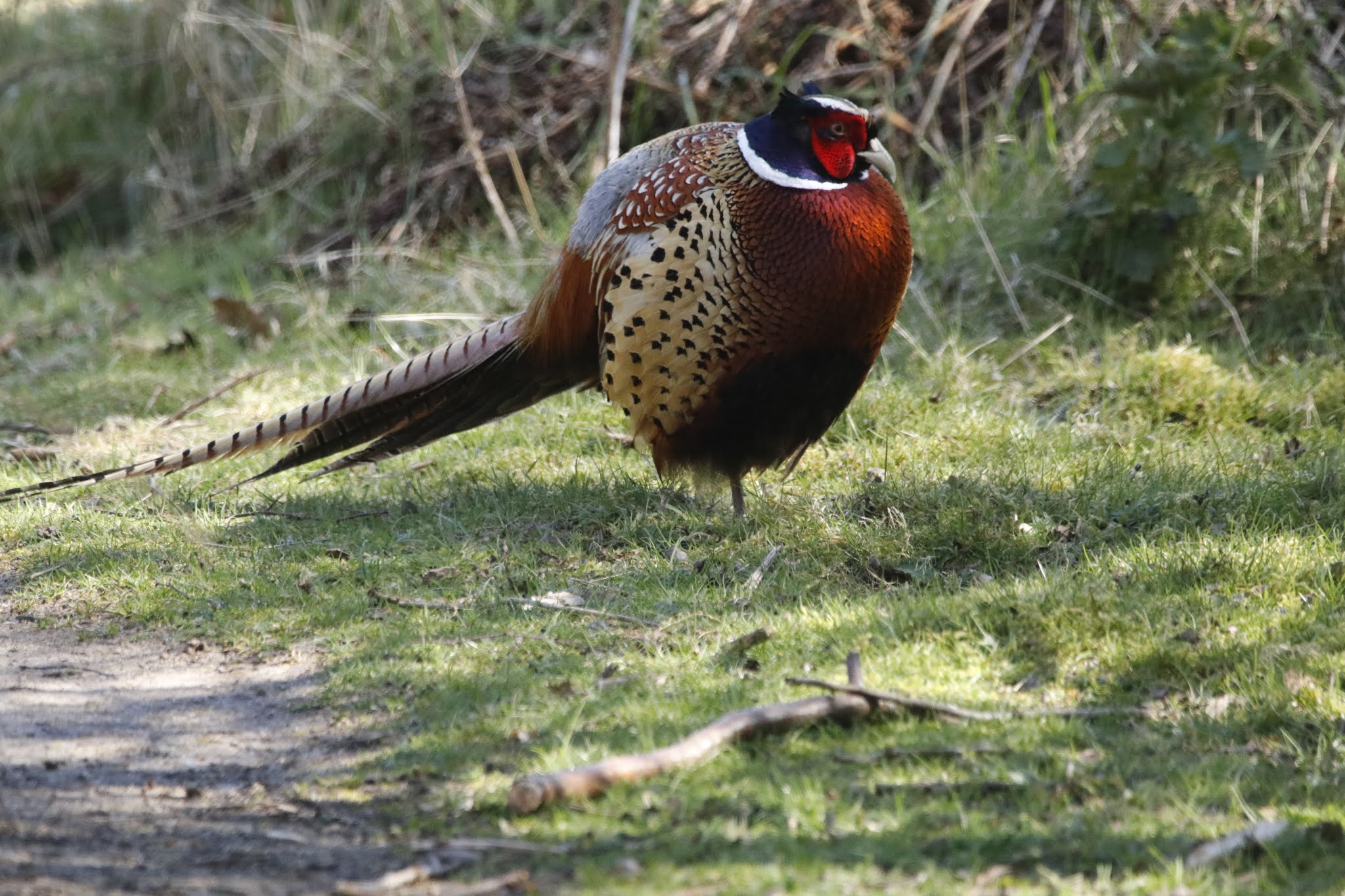
My first photo of the day - a male PHEASANT

At this time of year the Scrape is speckled with white as the thousands of BLACK HEADED GULLS nest on the Scrape. This is the most abundant species on the Scrape providing sanctuary to the rarer birds that nest here. Amongst them were the usual MEDITTERANEAN GULLS, a bird which looks similar to the black headeds but has a subtly different plumage, which stands out when you get your eye in. A small flock of 20+ SANDWHCIH TERNS were also present although their number could be higher as there was much interchange between the Scrape  and the sea. These large, black-billed terns are only an erratic breeder at Minsmere, so it s a case of wait and see as to whether they will settle down here or move on to somewhere else. A first summer LITTLE GULL, flew from the Scrape, over West Hide and over the reedbeds which was a nice spot, this is a good time to see them. As its name suggests its a lot smaller than the other gull species that inhabit Minmsere.


The Scrape is arranged geographically, E,S,W. This is the South Scrape seen from the Public Viewpoint

Out on the Scrape there were still plenty of DUCKS about, at this time of year the males look splendid, the brownie females less so. SHOVELLER were the most common, this beautiful duck nests at Minsmere in large numbers, there is a nationally significant population here. A few ducks of other species were about, including a pair of PINTAIL on South Scrape. There were lots of BARNACLE GEESE, these naturaliesd birds have taken over the Scrape and have ousted the other species of goose, which were also introduced, so don't feel sorry for them.


Across the beach to Sizewell, the gorse is home to many birds

With water levels high on the Scrape, WADERS were few in number. A nice BAR TAILED GODWIT in brick red breeding plumage was about on East Scrape, as well a a couple of TURNSTONE, some summer-plumaged BLACK TAILED GODWIT and a few RINGED PLOVERS, although the latter may nest here. Of the breeding waders, black and white AVOCET were in the largest number, probably the most famous bird of Minmsere, with LAPWING in the grassy areas in front of North Hide and some OYSTERCATCHERS, birds flying high to see off a marauding large gull. 


DUNNOCK

The Scrape is bordered on one side by the beach and it was here that attention was turned to the smaller birds. There were two pairs of STONECHAT present, one behind East Hide and one by the sluice bushes, these birds nest in the copious amounts of gorse on the beach, the smell of coconuts wafting down from these thorns. There were lots of LINNETS with several flying in from the sea, the birds actively migrating at this time. Opposite West Hide two singing SEDGE WARBLERS were a first for the year for me their agitated song erupting from the reeds. It will be a couple more weeks before the similar sounding reed warbler shows up.

SAND MARTINS nest in the old car park, a former quarry next to the visitors centre. Only a few birds were present here, but large numbers were about hawking for insects over the Scrape and reedbeds. It won't be long before they start to recolonise the holes in the sandy cliffs and settle down to raise a family.


These concrete blocks were put here in WW2 as anti-tank defences

High above the reeds MARSH HARRIERS were busy preparing for the breeding season, and although Island Mere hide was closed views over the reeds were still available. Out on the water there was a pair of GREAT CRESTED GREBE and some TUFTED DUCK, the usual breeding birds of this mere.

Although the birds are the most noticeable of our wildlife, Minsmere abounds in other forms of life. On the Stone Curlew Field a STOAT was briefly seen running across the heathy grassland. Similar but larger than a weasel, with rabbits now recovering from the last bout of mixamatosis, there was plenty of food for the stoat to hunt. On the Levels, an area of wet grassland close to Sizewell, a herd of 15 RED DEER, mainly hinds, were present grazing in the distance.


There's a sea of reeds at Minsmere

Although it was a quiet day at Minsmere it was far from uneventful. Being one of the best bird reserves in the country, there is always something to see. With the sheer number of birds nesting on the Scrape, it is always eventful. By Mid-May hopefully lockdown will have eased up some more and the hides will finally be open giving better views of the vast amount of birds at Minsmere. I can't wait.


Sunday, 11 April 2021

Early Spring On the River Gipping - 2021


The river Gipping winds its way through the lands of central Suffolk, a blue vein through a non-descript farming landscape. Industrial development, the creation of lakes and quarries through gravel extraction, has scarred the land, but also in turn, rather unintentially, created a good place for wildlife. Water is the basis of life, and the new pits have provided a home, replacing the older traditional wetlands that occurred by the river.


SWALLOWS Barham Pit A

The area of the river I birdwatch, between Ipswich and Needham Market, is a real hodgepodge of habitats over a large area of country, providing many a place for wildlife. This large variety in the landscape means I'm not stuck with just one place to birdwatch, but can pick and choose different access points to the area, which makes it less boring. The period I've covered here runs from Mid-March to Mid-April, the beginning of Spring. Around this time winter birds are leaving and summer birds are just arriving creating an exciting time for migrants, with the potential for anything to turn up.

Pipps Ford

Male CHAFFINCH

The best birding site in the Gipping Valley, Pipps Ford is a variety of habitats, ranging from active quarry, open water, woodland to rough grassland. I visited the site on 9/4 a rather uneventful day, but its the first time had visited the site in a while.

The site is well traversed by footpaths giving good views of the different habitats. First up is the exhausted quarry, where ever since I have been coming here the land has been finished from any digging and now lies fallow for wildlife. Today the water levels have been raised much more than usual and is now a shallow pool with emergent trees. Nestled amongst those unindated trees were three COOT nests and one LITTLE GREBE nest, little bundles of sticks with a female bird hunkered down. On the short grassland around the quarry three pairs of LAPWING were on territory, making this the main site for this species in the area.


Pipps Ford

As the path leaves the exhausted quarry it meets the actual ford on the Gipping, an artificial construction, and then moves north along the river. The path leads as far as Riverside Farm Pit, a small open area of water which had only a pair of COOT and a pair of SWANS, as well of loads of GEESE.

Away from Riverside Farm is Pippins Lake, another small pit, but which is less open, surrounded by trees, a seclusion which stops any disturbance to the birds on the lake. There was a good mix of wildfowl here with seven GADWALL, five TEAL, one TUFTED DUCK, a pair of COOT and a nesting SWAN.


Pippins Lake

Up from Pippins there is the Active Quarry, the footpath leading up to the back of the working site. It was busy with workers, diggers, bulldozers and a constant stream of trucks. The owners of the quarry are contractually obliged to landscape the quarry for wildlife when the works end. At the moment the quarry looks like a deep lake in the sand, but with several islands on the water, is looking good for birds. This attracted a few wildfowl, with a pair of displaying GREAT CRESTED GREBE and seven TUFTED DUCK around. The muddy edges of the quarry are good for WADERS, today there were a GREEN SANDPIPER and the first LITTLE RINGED PLOVER of the year.

Barham Pits

EGYPTIAN GOOSE Barham Pit B

Way down the Gipping from Pipps is Barham Pits, three fishing lakes straddling the river. This is a fairly industrial area, sandwiched between the A14, various warehouses and industrial lots and the village of Claydon. Its not a great site for birds, but is better in summer providing a home for them to breed. I have mentioned in many past posts how the new owners have destroyed a lot of the old river and lake trees, and areas of reedbeds, so I wont say anything more.


Seriously pruned trees along the river

No unusual birds were present, just the usual birds of gravel pits, which is strangely a rare type of habitat in Suffolk. There are three lakes in total and  from north to south are: Meadlands, the most northern lake, a small, tree lined pit with a pair of GREAT CRESTED GREBE and a pair of COOT; Barham Pit A had just a pair of COOT. However of interest was the flock of 15 SWALLOWS, on 6/4, my first of the year flying around the water, hawking for insects and also resting on the telephone lines, they were also accompanied by a couple of SAND MARTINS as well.


GREAT CRESTED GREBE

Barham Pit B is by far the largest lake in the area making up a large chunk of water with wooded islands, although it has been hugely trimmed back by the new owners. There were two pairs of GREAT CRESTED GREBE, a pair of SWANS, with another one on the river, a pair of COOT and a pair of GADWALL. The nesting COOT had already hatched young, the first of the year, with several tiny red-headed chicks poking their heads out of the reedy nests. Of note was a lone EGYPTIAN GOOSE on the 24/3 a rare bird here.


Nesting COOT

Papermill Reedbed

An area I have been concentrating on this year is the range of water meadows around Papermill Reedbed south of Barham Pits. I have described the area more fully in a previous blog, dated Mar 5 2021, so have a look there to get more information. 


The mill, now an apartment block

I visited the site on the 24/3 and 6/4, but it was fairly quiet on both days. 20 REDWING at the end of March were the last of the year, and where the meadows broadens out to the north of the site a SKYLARK was singing.


Along the river at Papermill Reedbeds

North under the overpass of the B1113 and beyond, the river becomes scrubby and held more smaller birds. A pair of BULLFINCHES were a good sight as well as a pair of RED LEGGED PARTRIDGE. You may think the latter record strange, but with no shooting estates nearby, and therefore with no artificial introductions, these birds are quite rare and this is a first record for the area for me.


ROBIN


In conclusion then, a fairly quiet time on the river. Spring has really just begin, so its early days still. Soon the bird migration will speed up, when more summer birds will arrive in the country, flowers will open and butterflies emerge. The river Gipping will attract them all, being a natural highway. This long blue snake provides sanctuary to wildlife in central Suffolk like no other land form does. It will keep attracting wildlife and I will keep visiting to watch that wildlife. Long may it flow.