Tuesday, 13 July 2021

The Farne Islands - 17/6/2021


This group of PUFFINS are in close talks with each other


The centrepoint to my holiday in Northumberland was a trip to the Farnes. These islands are home to hundreds of thousands of sea birds that nest on the cliffs and remain undisturbed by anything like human civilisation. Due to the coronavirus pandemic lockdown still in operation, we were not allowed to land on the islands. Instead the bird spotters like me had to take a boat trip around the islands in and out among the cliffs and the many, many birds. We certainly got our money's worth, with no less than three and a half hours spent on the sea, so if you're in the area its well worth a look.


I departed for the Farnes from Seahouses harbour, on an open boat which allowed us to sit through the boring parts, yet gave enough space to stand up to take a photo. In the harbour, EIDERS were present, with several broods of little brown ducklings bouncing around on the water. 


The sheer cliffs are loved by nesting auks

Out on the water, to begin with, there were no birds present as we sped towards the islands. But the closer we came to the Farnes, the numbers of birds began to build. First there were the odd birds, singles that would fly off when approached by the boat, before growing in number as we got closer to the islands.


A group of GUILLEMOTS, the most numerous bird on the Farnes

The bird present in the highest number was the GUILLEMOT. These brown and white birds nest on the cliffs in huge numbers, where up to fifty thousand of them can be present round the islands. Nesting in tiny little territories, on the cliff face, they weren't too fussed by the boat, flying away when we got too close, but fairly chilled, allowing for nice close-up photos.


It didn't take long to get to the islands. The first set of islands are dominated by Inner Farne. This is one of the two islands that used to be accessible for visitors, where people could disembark to take pictures of the birds nesting on the islands. However due to the pandemic no entry was allowed. This restriction also applies to wardens and as a result there has been no management on the islands. This has had an unhappy consequence, for without this management the vegetation has grown too long, which has had a knock-on effect for the ARCTIC TERN colony. The terns prefer the shorter vegetation on which to nest, but now it has grown too long for them and the bird which nested there in huge numbers has seen its large colony collapse this year.


RAZORBILL (l) and GUILLEMOT (r)

Outnumbered by the guillemots, by a large ratio was the similar looking RAZORBILL, another bi-coloured auk. As with all birds there are ways to tell them apart if you take the time. The main difference is that the razorbill has an impressive large, thick bill, like a barber's razor, to which in comparison the guillemot's is quite dainty. The less noticeable difference is that the razorbill has black upper parts whilst the guillemot's is brown.


The GUILLEMOTS would allow the boat to come quite close

After Inner Farne the rest of the islands were dominated by sheer vertical cliffs rising from the sea. The cliffs of the Farne Islands although not overly tall, are dramatic and the bird populations on them are huge. The best way to describe these bird population as are sea bird cities, the populations here numbering that of a small size British city. With no humans and no disturbance the birds had total control of the islands and were free to nest everywhere and did so in profusion.


The first two auks described, the razorbills and guillemots, would allow the boat to come close, some moving away, some flying, but were not overly fussed. The PUFFINS, however, would fly away on their stubby little wings if the boat came too close. Beautiful and popular birds, their over sized multi-coloured beak is always a pleasure to the eye. The puffin is the original and northern hemisphere penguin, with the exception they can fly. Unlike the other auks, puffins didn't nest on the cliffs, instead they nest in burrows on the island tops out of view of us down in the boats. Occasionally I would get a photo of them on a cliff top, but usually they were down on the sea. The majority of my photos were of out of focus puffins flying on the sea.


SHAG

SHAGS as usual were common, out numbering their larger, blacker cousin the CORMARANT. Shags are smaller and are a green colour, but are less familiar to people down south, unlike the wide ranging cormorant. KITTIWAKES and FULMARS were also present in large numbers. Kittiwakes are our true "sea" gulls, only ever coming to land to nest on these sea cliffs. Fulmars resemble gulls but are from a different family and have stiff wings, limbs that don't bend. Like all these sea birds they are just here for the summer before returning to the vast seas over the rest of the year.


GREY SEAL, there were plenty of them basking on the rocks

GREY SEALS live in the area in their thousands and many were seen today, whether a head bobbing up in the water or a full body resting on the rocks. The UK has a large chunk of this species' global population, where they are doing perfectly fine. Seals are my favourite wild mammals, such intelligent, inquisitive animals, that watch you  as you watch them, truly the most charismatic of wildlife.


The boat made its way through the islands stopping off at interesting points to allow us on board to take photographs. The main criticism I aim is at myself, how I spent all my time taking photos, without taking the time to really take it all in. I failed to pause and just appreciate what was going on around me. It was just there were so many photography opportunities, that I maybe saw the whole wildlife experience through a lens. In the end I took around a thousand photos. What fun it was wading through them to create this blog.


A wildlife spectacle like no other, the seabird cities of the Farnes are truly something to be seen. Only a few places like this exist in the world, so each place must be guarded. Although the birds are doing well, overfishing and other negative activities on our seas are having a negative impact on these birds. As with all conservation problems, the solutions are fairly simple, its just that people can't accept change. Anyway, the birds are still here, so go out there and see them.

Friday, 2 July 2021

Druridge Bay Reserves - 15/6/21

Male STONECHAT

Further down the Northumberland coast are a series of lowland wetlands set back from the sea. Based around old opencast mines that have been left to become overgrown by nature, which has resulted in them mainly becoming large lakes, they make for good birdwatching country. Managed by the Northumberland Wildlife Trust under whose guise they have been carefully managed for wildlife, these reserves are a haven for birds. Connected to each other by a ramble down the coast, they are accessed along the long distance footpath which snakes its way from reserve to reserve . These are quite important Northumberland reserves and I've been wanting to see these them for a while and now I finally got the chance.

Hauxley

The first reserve I visited was Hauxley, the most northerly of the reserves. Its a focal point for the area, with toilets and a café providing civilised amenities absent from a lot of nature reserves. The reserve consists of a large lake surrounded by hides with a small amount of peripheral land. The lake had a variety of islands and were a haven for birds.


The main lake at Hauxley

The most obvious birds were the GEESE with hundreds present, these birds have increased to almost plague like numbers and at a lot of places are out numbering and out muscling all the other birds. DUCK wise there were also some TUFTED DUCK, GADWALL and a pair of SHOVELLER present, the usual birds of this kind of habitat at this time of year. There were some roosting GULLS and TERNS, but nothing special.


The flock of TREE SPARROWS at Hauxley

Probably the most sought after bird on the reserve was the TREE SPARROW. This is one of those birds which used to be extremely common right across the country, but whose population crashed due to the increased industrialisation of agriculture in the countryside. Nowadays there's only a couple of pairs in Suffolk, so they are difficult to find at the best of times. They are similar to house sparrows, but are birds of the countryside and are seldom seen in areas of human habitation. At Hauxley they were seen from a special hide, over looking some bird feeders which attracted a flock of the birds. Strangely enough the viewpoint was called the Skua Hide, the least appropriate name for a hide possible, really. Also around the reserve it was good hearing a WILLOW WARBLER, a once common bird that has become extinct on the Suffolk coast, although its still common up north.


GEESE and roosting CORMARANTS

From Hauxley it was a walk to the dunes and from there I wondered down the coast to the next reserve. There was plenty of nice, easy walking available, either walking the long distance footpath, or simply walking long the beach.

East Chevington

This reserve was a huge lake formed from opencast mining, with a reed periphery. Being June not much was present, because at this time of year the birds are in low densities as they nest. It is in winter when the birds all join together, creating large flocks so a visit then is probably the best time to visit. Present today was the same sort of  birds as Hauxley, a few DUCKS, some GEESE, although not as in high numbers.


In a field just behind the dunes a herd of HIGHLAND COWS were grazing

A second, smaller pool, held a large stand of reeds where a female MARSH HARRIER was quartering. Speaking to local bird watchers, they were really chuffed to have harriers nesting here, with five pairs present. Me, being from Suffolk, am much more blasé.


MEADOW PIPITS were common in the dune system

Walking down the coast along the coastal footpath from East Chevington, the path travelled down a large stretch of dunes. This large amount of rough grassland was really good for birds. Three pairs of STONECHAT were present along this route, as well as large numbers of MEADOW PIPITS and SKYARKS, often in song and display flight. A common flower in the dunes was the beautiful BLOODY CRANESBILL, a deep red flower low growing in the rough grassland. At one point a MED GULL flew over, giving a nice record.

Druridge Pools 

The final reserve I visited today, although there is another one further down the road, was Druridge Pools. At Druridge a hide overlooks a pool in some wet meadowland, and another a former opencast lake. The wet meadowland pool had a variety of breeding waders, with some young AVOCETS present. Two ROE DEER were frolicking in the higher land behind. The lake held the usual wildfowl.


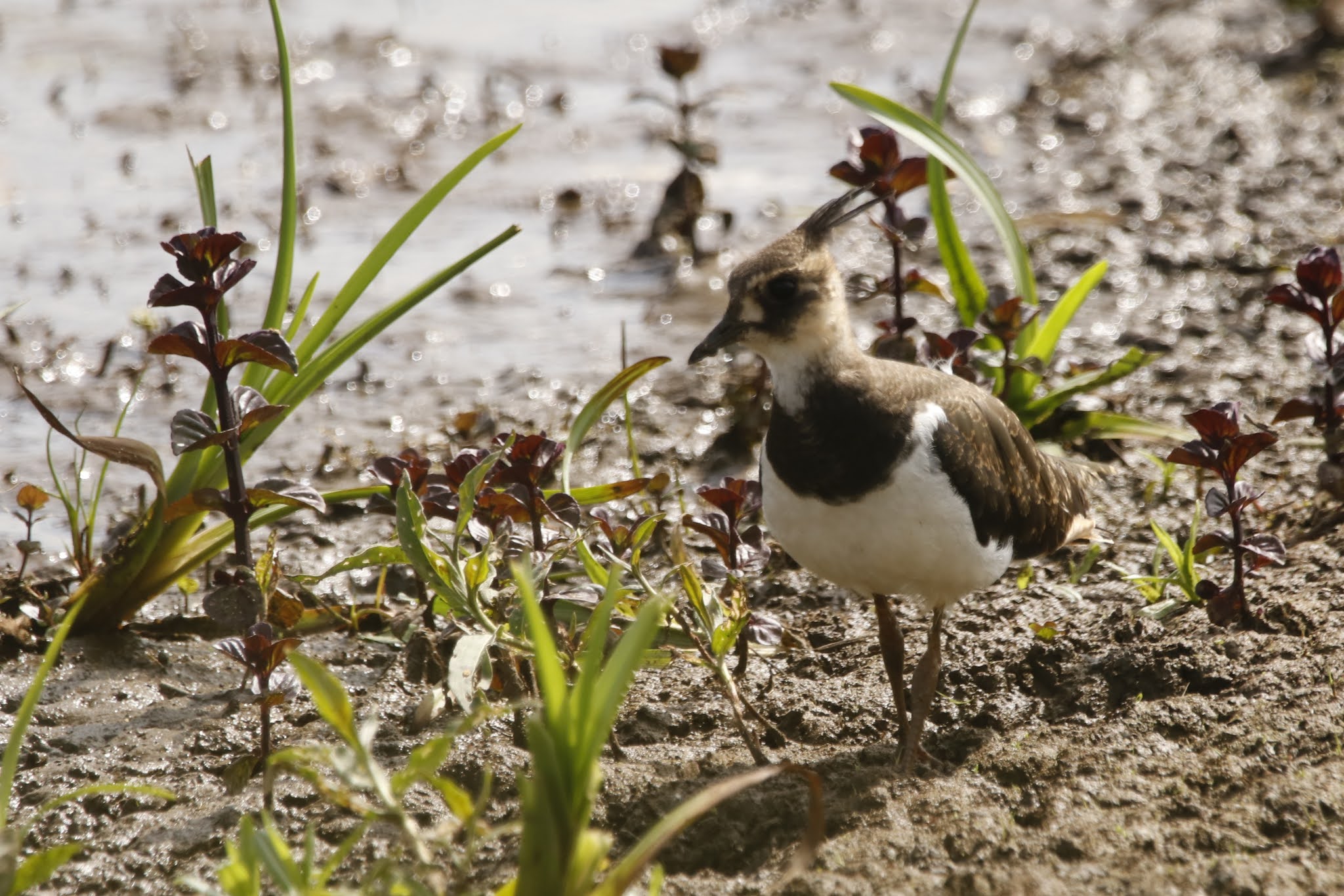
LAPWING were common on the wet grassland at Druridge pools.

A nice exploration of some Northumberland wetlands, a bit different to the bird cliffs further up the coast. These are probably the best area of freshwater wetlands in the county, and although I visited at the wrong season I still saw some good birds. Such is the variety of decent bird watching sites in the county, you can make several visits to Northumberland and still spend your time exploring new areas .


Monday, 28 June 2021

St Abb's Head - 14/6/2021


GUILLEMOTS

On the first day of my holiday in northumberland, I decided to leave the county and headed over the border for a call on St Abb's in Scotland. A National Nature Reserve, owned by the National Trust for Scotland, the place holds dramatic cliffs which attracts large sea bird colonies. Something lacking from the birdlife of Suffolk are the sea bird cliffs that provide the coastline to this area of the country. Soft Suffolk lacks the majestic landscapes that provide a home to the sheer numbers of birds that nest here at St Abb's. These bird colonies are the reason why I came up to the Border region for a holiday.


The guano - the birds droppings - stain the cliffs a distinct white

You really get a feel for the place from the start. The footpath starts off easily enough, winding its way through gentle, civilised farmland, giving nothing away as to what was coming up. But then this farmscape drops away, and the cliffs open up before you into this stunning vista. Sheer, foreboding cliffs, sea bird colonies and a footpath rising high into the hills. The landscape was stunning, as good as any reason to visit really. The reserve takes a lot of heavy walking, but it takes you far above the cliffs to enjoy the bird spectacle taking place below.


The rugged cliffs with its many clefts are a haven for nesting birds

Although there are a lot of birds nesting on St Abb's, its not as breathtaking, bird wise, as you would expect. In comparison to the Farnes, St Abb's is rather modest in its bird numbers. The sheer number of people that visit the reserve mean that there are no sea birds nesting near the top of the cliffs. A lot of people walking the reserve has disturbed birds from the cliff tops. The auks then, tended to nest half way down the cliffs, well away from the people, with SHAGS nesting even closer to the water. But this is a minor gripe really.


Smaller bird colonies nested on the cliffs

You could tell where the sea birds were nesting on the cliffs because the rock underneath would be painted white, from the guano of the bird's droppings. The smell and the sound of these bid colonies were really visceral, providing a feast for the senses, full on birdwatching.


Spectacular views

There are no puffins at St Abb's, but the rest of the usual suspects were present. The most numerous bird was the GUILLEMOTS with lots present, with smaller numbers of  RAZORBILLS, as well as FULMARS, KITTWAKES and SHAG. Offshore, but not nesting here were plenty of GANNETS, these large white birds fly hundreds of miles in search of food to feed their young at colonies further up and down the coast.


A ROCK PIPT, notice the black legs and darker plumage than the mippit

An overlooked bird, but one that provided an interesting record was that of the HOUSE MARTINS. Common birds, sure, but as inhabitants of the built, manmade environment. But strangely enough, here at St Abb's the sheer cliffs provide them with their natural nesting environment, which the human's buildings came to mimic. Here was an example of how the natural environment of a bird has been recreated unwittingly by us humans how we can be a force for good. Also present on the rocky shore were a few ROCK PIPTS, much darker than the more commoner MEADOW PIPIT, which were also present, with black legs and a distinct monosyllabic call.


Growths of THRIFT carpet the grasslands of the cliff tops

The headland is rugged, giving a good physical workout, walking its undulating footpath, but it never ventures into anything too hard like scrambling. The path takes you over the cliffs before reaching the lighthouse, where the footpath loops inland. The grassland that are set back from the cliffs, which the path wanders through are carpeted in the pink flowers of THRIFT and the yellows of BIRD'S FOOT TREFOIL a beautiful palette of colours, something that has become so rare in our industrial agricultural landscape, but at one time were fairly common.  A feast for the eyes and an earthly pleasure indeed, like all wildlife experiences.


A LESSER SCAUP (r), a rarity from North America on Mire Loch, with a female Tuftie (l)


I was disappointed with my shots of the bird, they never came out well.


These are just record shots of the bird. Notice the pale grey back of the bird, this is what alerted me to the bird amongst the black backed tufties


As the path reaches the lighthouse at the end of the headland, the path loops inland, round Mire Loch. It was here where things took an unexpected turn. Mire Loch is a long and thin stretch of water, surrounded on both sides by the high ground of St Abb's. REED BUNTINGS sing from the emergent reeds and NORTHERN MARSH ORCHIDS flower on the marshy sides. A flock of TUFTIES were present and whilst counting through them I noticed a strange duck, the size of a tuftie, but with a grey back. Was it a LESSER SCAUP? I hoped, I dreamed it was. 


The colonies of sea birds aren't as large as the Farnes, but still spcetacular

The original email I sent to the Scottish Ornithological Club asked them if the strange duck I saw on Mire Loch was a LESSER SCAUP. Several emails, with a photo attached, were exchanged with several local bird watchers, and in the end it proved that it was. And believe me it was unexpected: a lesser scaup in June? It came from nowhere really. It was from the National Trust ranger who I got the final confirmation. He had seen it the same day, but at a later time. So I was the first to see it. This is the first time I've seen a bird of this species, so it was a lifer. Total bragging rights. Not bad for a strange visitor from Suffolk.


The town of St Abb's which gives the headland its name


Because the bird was mated to a TUFTIE, it was a potential nesting bird, and therefore it was not going to be advertised, even if the youngsters would have been sterile hybrids. Imagine having nesting lesser scaup in Scotland, that would be ace. And despite the loch being walked past by thousands of people it seems no  one would notice the strange looking duck from another hemisphere idling its life away there. I'm still surprised that I saw it at all. Maybe in my past I have walked past many rare birds just like it without noticing.


A pair of SWANS resting on the footpath by Mire Loch. Swans can be very grumpy, so I had to give them a wide berth

LESSER SCAUP originate from North America where they are fairly common. This bird got blown across the pond, and now can't go back. Forced to wander across the country, in the company of similar TUFTED DUCK, this bird is an alien in a strange world. And as for the TUFTIES, there were around twenty in total, with some coots and mallards also present, quite a good showing really.


One of the GUILLEMOT colonies

What a surprise this reserve had for me, in the form of an unexpected lifer. A mid June sighting of a lesser scaup, mixed in with some good views of  sea birds. It was also good walking country energetic but not too strenuous, walking this rugged landscape. This is the kind of reason why I go to the bother of going out to places like this, it can at times really pay off, and yes I well recommend a  visit.


Thursday, 24 June 2021

Northumbria & Budle Bay - 13-19/6/2021

GUILLEMOTS!

With a world slowly opening up before me as lockdown gradually eased up, new vistas appearing and hearing the birds calling me, what better time to take a short holiday. With a desire to see the world beyond Suffolk, Northumberland seemed the best option available, to recharge the batteries and restore my soul. June is the perfect time to visit, to witness what is one of Britain's best wildlife sights, the sea bird colonies that line the coast of this picturesque area. Compared to Suffolk Northumbria is a rugged land, but is still within the bounds of civilisation, with cultivated land, whilst still being very touristy, yet wild with the add ons of comfort.


The GUILLEMOT cities of the Farnes


It was a short stay, I would spend five full days in Northumbria, with days spent roaming the coast on the look out for birds, and the conditions favoured me. Whether it be the sheer spectacle of hundreds of thousands of birds on the Farne Islands, to the robust walking of St Abb's Head and the more civilised nature of the Druidge Bay reserves, there were lots of birds. Because although numbering in the hundreds of thousands here in Northumbria, these sea birds are quite rare in East Anglia, where Suffolk records maybe a couple of puffins a year, distant specks on the sea. And throw all that in with a self found lifer - a LESSER SCAUP hidden in a flock of tufties - there were good rewards.


A pair of GREY SEALS


However this trip has a tinge of sadness. This may be my last trip up here, the last time I visit the area. I have visited Northumberland four times now and have visited a lot of its bird sites and seen a lot of birds, but its now time to say farewell as I set my eyes to further lands. There are just so many places to go bird watching, even in the UK, so many birds to see and that keeps a good vibe flowing within me.


View from the flat of Budle Bay

Budle Bay

Whilst in Northumbria, I stayed in a flat which looked over Budle Bay, a small estuary which forms the southern part of the vast Lindisfarne National Nature Reserve. The bay is a bulge of mud that opens up inland from the sea. The views from the flat were fantastic giving large vistas of this tidal estuary as it sprawled out in front of me. The water was deceptive, as for most of the day the tide was out and the estuary would just lie there, then an hour before high tide the water would rush in filling the sandy mud flats in minutes.


Male EIDER

Being June the numbers of birds were at their lowest. A maximum of six CURLEWS, six OYSTERCATHERS, and one REDSHANK, were the only WADERS. The curlews represented the beginning of Autumn migration, failed breeders returning back to their wintering grounds. This is really one of those strange caprices of nature that autumn is underway so early, when other birds are still nesting and busy raising families, there is only a small gap between spring and autumn. Autumn is always a prolonged season and can last for months, as there is no real rush for the birds to go anywhere.


Male RED BREASTED MERGANSER


Wildfowl numbers were again low, there being a maximum of four RED BREASTED MERGANSER along with some EIDERS. The eiders had some ducklings with them, again this is a common northern bird that's scarce down in Suffolk. A pair of MUTE SWAN were in the area, the birds would rest on an area of mud, a little hump above the water, not doing much for long periods of time, it was so interesting to watch them from the flat. They never strayed far and they always seemed to be in the area, although they showed no particular signs of breeding. A lone BRENT GOOSE was on the mudflats, a bird that didn't want to head north to breed, instead spending its lonely time here during the nesting season. Plenty of TERNS would visit the area, COMMON and ARCTIC being the most abundant, with a couple of SANDWICH, and one LITTLE seen splashing down into the water to catch a fish. 


A flock of juvenile STARLINGS would fly down to feed on the tideline.


I would visit a lot more bird places across the course of the holiday and I would see a lot of birds on the wildlife rich Northumbrian coast. I shall post site specific posts later on in my continuing blog of what its like to be an early 21 century bird watcher.

Wednesday, 9 June 2021

Turtle Dove Survey - 9/6/2021 & 7/7/2021

Juvenile GREAT SPOTTED WOODPECKER, proof of breeding in the area

Unfortunately I recorded no turtle doves on both the survey days. Its a shame as the turtle dove is declining rapidly. At the start of the millennium turtle doves were still relatively common in Suffolk, but are now very hard to find. As part of the survey I was given a square on the map to look for this bird. It was located on the edge of Hintlesham, out Hadleigh way, a path that winds itself through the local golf club. As per every golf club, there was lots of lush fertile grass, with bordering woods. However there wasn't the right type of habitat for turtle doves, who need overgrown scrub with weedy fields. I walked all over the place and I clocked up two hours worth of searching, both times, but all in vain.


The dew on the golf course burning up in the early morning sun

There was lots of wildlife about despite everything. I woke up early to arrive just after dawn. I parked up around five and soon entered the survey square. A FOX was seen roaming the footpath ahead of me. He saw me, gave me a look of 'what are you doing here, this is our time, not human time' and just sauntered off. I also encountered a MUNTJAC with fawn, I know they are a pest, vermin perhaps, but they sure look cute. A HARE briefly ran in and out across the golf course. Later on, whilst in some farmland I encountered further HARES, a pair, who gave me a look of surprise, like they've never seen a human before. This truly was wildlife time.


It was a good place for GREAT SPOTTED WOODPECKERS, with the pictured bird, a juvenile, and another one drumming from a different wood. I kept my ear out for the purring that gives away the presence of a turtle dove, but all I could hear was the WOOD PIGEON and the STOCK DOVE.  common bird.

On the second survey morning things were a lot more quiet, with not much happening. I was tired and bored, just going through the motions, something I had to do, rather than something I wanted to do. 

So there were no turtle doves in my area, probably a statistic shared across a lot of squares. Its such a shame as they are such a charismatic presence in the countryside, one that if we changed our farming practices just a little bit, could easily accommodate them.


Monday, 7 June 2021

Trimley Marshes - 4/6/2021


The SHELDUCK do like to squabble among each other


I don't know why I do it, maybe its something masochistic lying deep down in my psyche. A four hour trip, walking and walking, to push myself that little bit too far only to see not a lot. Its Trimley Marshes, a reserve designed to knacker you out. Its three miles from the nearest road so its a long walk. Sometimes Trimley is good, a lot of times its not, and you have to walk far to find out. It doesn't help when you have to do the walking in monsoon like conditions.

Male REED BUNTING are quite photogenic at this time of year when they often sing from a bush in the reedbeds

Today was alright, that's all, as you would expect from the reserve in the mids of summer and the breeding season. It was a nice walk before the heavens opened. I parked up at Levington Marina, as usual, where there is access to a footpath. However the owners are now cutting off the main footpath with a fence, which may mean there will be no future entry, and could mean finding another parking place. As I arrived the tide was mainly in, but it didn't really matter, being June there were few estuarine birds about. A few OYSTERCATCHERS and plenty of SHELDUCK was pretty much all.


Just out of the Marina is Loompit Lake, an artificial fishing lake, which has nice tree bordered margins, good for wintering and breeding waterbirds. The CORMARANT colony is a feature, although being a fishing lake the owners have been given a license to cull the birds. Only a fraction of the size it used to be, only around 20 nests were occupied. Most of the nests had quite old chicks, these birds start nesting early, the trees underneath have been dyed white by the guano produced by the nests.


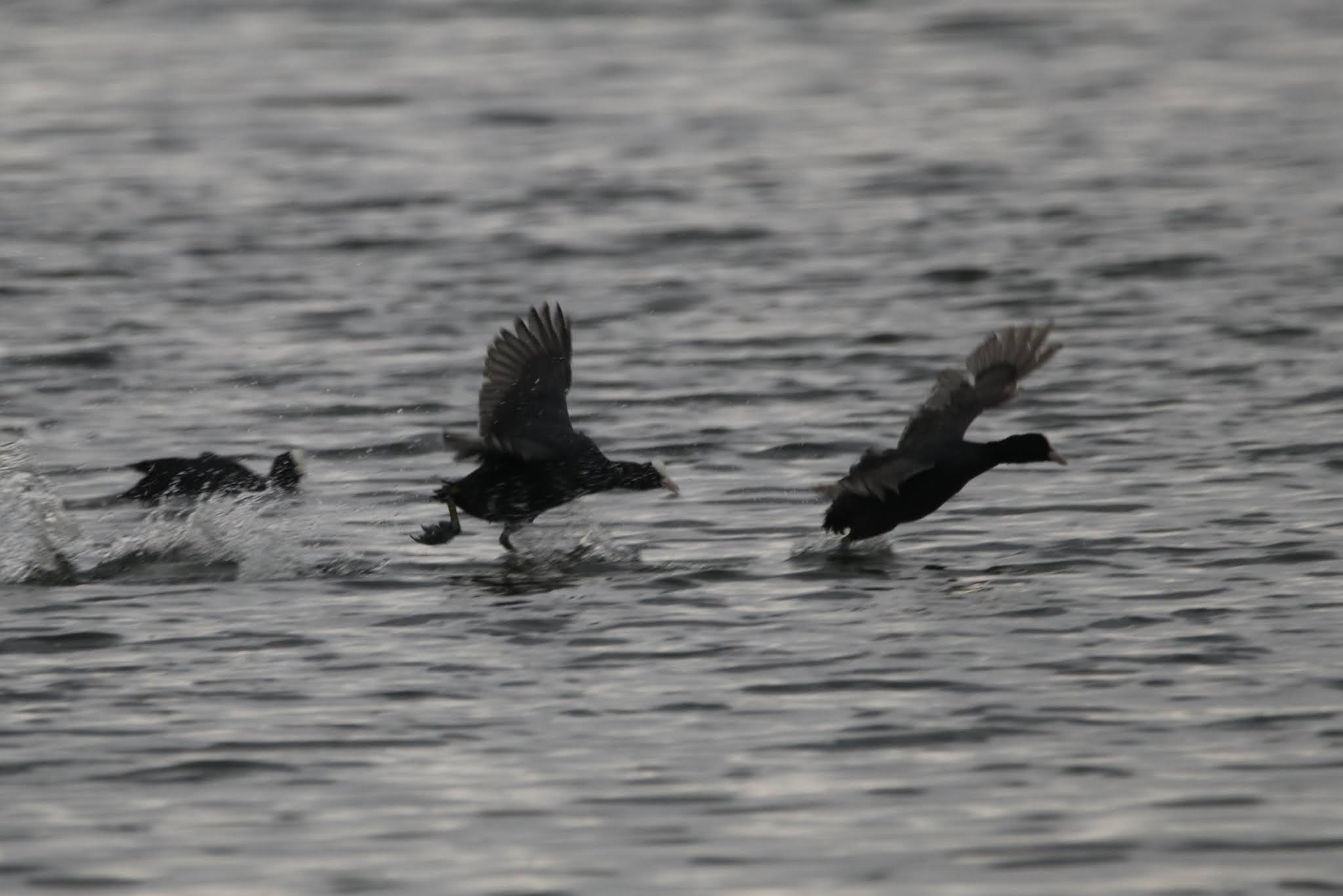
COOT also like a squabble, this time over territories, on the Reservoir

The usual wildfowl were about, the odd pair of POCHARD, Loompit and Trimley are the main nesting locations for this species in Suffolk. There was a smattering of TUFTED DUCK, three pairs of GREAT CRESTED GREBE, two SWAN broods, the odd LITTLE GREBE, and loads of GEESE. A YELLOW WAGTAIL was  flying about the path, having an altercation with a PIED. Its been a while since I have seen one here, they used to be common, so I'm not sure if this is an oversummering bird or a late migrant.


The Managed Retreat


The walk to the managed retreat was quiet. The Managed Retreat is an area where the sea wall has been allowed to breach some farmland, as compensation for development of Felixstowe Docks. The tide was out but had little new. A HOBBY hunted over farmlands by the Marshes, and a lone BRENT GOOSE was on the river on the other side to the Retreat. One of the last wintering birds to leave, its hard to know if this goose will be an over summering bird, or a late mover.


Hide in front of the docks. The reserve was originally crested to compensate for new docks being built over mudflats

Finally getting to Trimley Marshes reserve, there's nothing particularly auspicious to greet you. A little sign announces you have made it as you spot the hides on the reserve banks. What differentiates the marshes from the surrounding agricultural land is the water. Hides overlook various pools and a big reservoir, which is a haven for wildlife, as water, although natural is scarce in our general landscape. Farmers love to drain their fields The first bit of  water, the Winter Flood, is the focal point of the reserve as its a good spot for migrant waders. Today its was only the breeding WADERS here. There were plenty of AVOCET, LAPWING, REDSHANK and OYSTERCATCHERS here, but no young birds. The next two pools were the SUMMER FLOOD and the PERMANENT LAGOON, which both held large numbers of DUCK, mainly GADWALL, with the odd pair of SHOVELLER and one TEAL. On the Summer Flood was a pair of BLACK SWAN. This bird  is a resident of Australia, so the chances of it arriving here naturally are nonexistent, so its obvious they are escapes. Who knows they might hang around and raise a family, colonising this area of the country with more black swans.


Female MALLARD, the Reservoir

The Reservoir was the final destination, a body of water that maintains the levels of liquid on the rest of the reserve. Its a large, reed fringed lake, usually busy with birds, but not really so today. There was the odd  pair of POCHARD, with a flock of 15 male present. Most of the wildfowl were like Loompit Lake, with TUFTED DUCK and COOT, one brood each of SWAN and GREAT CRESTED GREBE, as well as some LITTLE GREBE. A CHINESE WATER DEER was feeding on the Reservoir bank, another introduced animal, Britain now has an internationally important population. 


A BLACK SWAN cobb coming to land on the Summer Flood


It was whilst in the reservoir hide that the heavens opened up, a deluge of monsoon proportions. Checking on my phone how long it would last, I was told it was still sunny with the occasional breeze. It would not let up for the rest of the day. That was the weather that guided me back home, and the path had no shelter at all.

You always go out birding with the hope of seeing something rare. However at this time of year the odds on seeing something unusual are much lower than at other times. It really is a time for breeding birds, a time when birds stay at one site and only move to find food for their young. This lack of migration means less unusual birds are going to turn up. Sure, Trimley is one of the better reserves, with lots of breeding birds, but even so can be trying at times. Its just that long, long walk to see what's about, which can leave you feeling doubly disappointed when nothing much is about.

Wednesday, 2 June 2021

Breeding Bird Survey (BBS) - 26/5/2021


YELLOWHAMMER

The Breeding Bird Survey is a scheme that documents the highs and lows of breeding birds across the country. Run by the British Trust for Ornithology (BTO), it entails walking a transect, and noting all the birds that are seen as you do so. As you walk the transect, you record the birds out to the sides, and their distance, and whether singing or in flight. After you finish you then log the results online, and this will give a picture of the bird's fortunes in your transects over time. My transect happened to be just off the A1120, the Stowemarket road, which lies just across the road from Stonham Barns. It follows a farm track that winds its way through fields of rape, with a border of low cut hedgerow, and with the odd tree sprouting up. It ended with a set of farm buildings, which provided a different habitat. The survey entails two visits a year, four weeks apart, in Spring. This is the second of two visits, my first was in 21 April which I wrote a different blog entry for.


Clumps of RED CAMPION growing in areas of set-aside in the farmland. Once upon a time land like this was common on farms, now its sadly rare.

The most difficult thing about the survey was having to get up early in the morning, right up at the crack of dawn. I was able to get to the site at half five, walked up and down the track and finished by seven, leaving me free for the rest  of the day. At least the the weather was in my favour this visit. Although not particularly warm, it was early in the morning after all, the visibility was good, no wind, and not much cloud cover. On my last visit in April there was wall to wall fog, and I saw nothing, typical.


This was pretty  much what the surveying landscape looked like

All in all twenty species of bird were see in total on both trips, fourteen of them today. Being just intensively farmed land there were few birds encountered in the transect. Common birds like the great tit weren't recorded as there was no woodland or scrub. Considering the habitat it was fairly obvious that the most recorded types were those of farmland birds. LINNET were the most numerous bird, followed by YELLOWHAMMER. Set-aside plots cut through areas of the rape by the farmer meant there were decent numbers of SKYLARKS, serenading me with their beautiful song.


If you asked a birder what their least favourite bird was, most would say the PHEASANT. Millions are released into the countryside, unregulated, with only a tiny proportion used for hunting.
This one died of natural causes.

I also happened to see some HARES on my visit, I think at least five individuals. This is the usual kind of habitat for this mammal and the animals would run out of the rape fields, onto the track before seeing me and disappearing again. Hares are great to see, the diamond in farming county. As well as the birds I am also obliged to record all mammal sightings I see in the area as well. 


LINNET, probably the most numerous bird species on the survey

Its always good to use my bird identification skills for some good, to have some use for a lifetime of bird watching. Surveys like this rely on volunteers to provide the sightings that will end up being turned into an official report. Taking part in these surveys really makes you feel like your a proper birdwatcher, that you you've made it. Although its early days, I think this Spring, with its topsy-turvey weather has been a very poor one. Hopefully this is just a one off and next spring will see a return to normal.