Saturday, 5 March 2022

Carlton Marshes - 3/3/2022

GREAT WHITE EGRET


Carlton Marshes is the flagship reserve of the Suffolk Wildlife Trust, a behemoth of a reserve, created from some useless farmland to form a wetland bursting with wildlife. It forms a big part of the small Suffolk section of the Norfolk Broads, an area of long winding rivers and low marshland, with big skies looming over the sunken landscape.


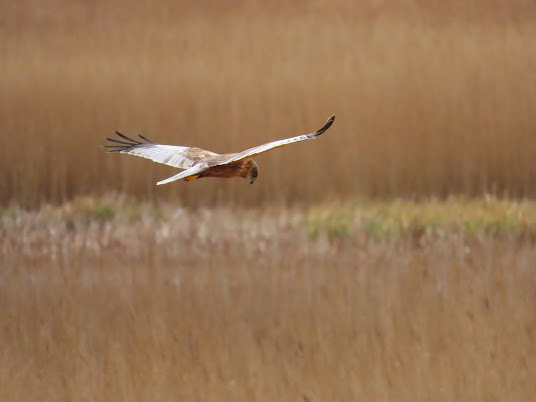
Female MARSH HARRIER

It has been a while since I last visited the marshes, and several seasons have passed, and the place is very much different. Gone are the lazy cattle grazed pastures, to be replaced by lots of water and flocks of birds. It was a day of winter, yet also the first glimmers of Spring, an inbetween time not quite one not quite the other.


GREY HERON

The focal point of the reserve is Peto's Marsh, a huge area of flooded grassland and reedbeds. The bird flocks were large, with hundreds of LAPWING bouncing into the air at the slightest whim. With them was a small flock of around twenty GOLDEN POLVERS, a bird which cohorts with them in winter times. DUCK numbers were still high, mainly WIGEON, but also with large numbers of SHOVELLER, with smaller numbers of TEAL and GADWALL. Four male PINTAIL were feeding among them. Star of the show, though not the most showy of birds, was a female GARGANEY, a bird which superficially looks like a teal, but has a distinct eye and forehead stripe. A female teal fed nearby and providing comparisons, the garganey was slightly larger, darker and crucially had a dark wing stripe. Garganey are our only summer visiting duck, and with only fifty pairs nesting in the country are scarce birds. This bird is my earliest ever record of this species.


Out on the marshes signs of the upcoming breeding season were in motion with several pairs of REDSHANK returning, a pair of AVOCET, and three noisy OYSTERCATCHERS, whether a pair protecting their territory from an intruder or two aggressive males chasing a female, I'm not sure. A GREAT WHITE EGRET was present flying around the site, at one point confronted by a GREY HERON, to whom he turned his back on. The egret was actually taller than the heron, a truly impressive bird.


The low lying marshes make for good bird of prey country, and today there were large numbers of MARSH HARRIER present quartering low over the landscape. These new marshes have given these impressive birds of prey plenty of land to hunt over. Another reedbed specialist was the BEARDED TIT, heard calling from Peto's Marsh, although unfortunately I didn't see any.


CHINESE WATER DEER

A characteristic sight of Carlton Marshes are the CHINESE WATER DEER found there. Two animals were present on Peto's Marsh, observing me as a I observed it. In full gait it resembles a giant rabbit. It doesn't have antlers, instead it has giant canine extending from its top lip. As its name suggests it originates from China, and naturlaised here having escaped from deer collections, finding a niche for itself in our countryside.

OSPREY on the Blyth Estuary

Driving back down the A12 I decided to stop at the Blyth Estuary for a quick look, and I was glad I did so. Arriving on the river wall I noticed a bird of prey flying in the distance and taking a look was amazed to ID an OSPREY.


MUTE SWAN on the marshes

Its shape and white colour identified the bird immediately, and although it was distant was fairly easy to make out. This was a great find, ospreys are such iconic birds, their history in this country is such a milestone for the conservation movement. I don't have the space to write about it but if you have any spare time I recommend looking up the story of the osprey.

The osprey is a summer visitor and like the garganey earlier, this is my earliest record of this species. On the estuary itself, the tide was low, and not much was around, the usual DUCKS and WADERS, including some AVOCETS. 

What an impressive county to birdwatch Suffolk is. And when new ones are created things are even better. However despite more reserves being created, there is still large scale destruction of the countryside, ones that nature reserves can't compensate for. Don't get me wrong, reserves are good, but what we need is for our wider countryside to be managed more in tune with nature.

Tuesday, 1 March 2022

Minsmere - 24/2/2022

Male MARSH HARRIER

Driving to Minsmere, I enter the fringes of the reserve, passing through the extensive woodlands, layered by growths of brown bracken, under the bare branches of the birch trees. And as I pass these it finally feels that I have arrived at Minsmere and my thoughts turn to what birds I would see. For a late winter's day, I was expecting to see wildfowl, and maybe some something else rare. Minsmere has that magic which soon drags you into its green soul.


Looking across the Scrape from the Dunes

What a tumultuous day it was at Minsmere, a constant conveyor belt of different weather patterns, rain sleet, hail, and sun. But with the mild winter, thoughts of spring are in the air, and with such a warm season we have had it wont be long until our resident breeding birds start to get more active. But despite all this there were still a lot of winter birds hanging around.


MUTE SWAN

Being the last gasps of winter DUCKS dominated the scene, and today there was a good selection of these waterfowl around, birds starting to move as they gear up for Spring. From a rarity point of view, top billing must go to the pair of SMEW on Island Mere, a beautiful monochrome, black and white male, with a more subdued "red head" female. These are proper winter scarcities, ones birdwatchers are constantly on the look for and luckily being ducks they tend to linger so are quiet easy to catch up with. Island Mere was fairly quiet but also held a WHOOPER SWAN, with two pairs of GREAT CRESTED GREBE also turning up for the breeding season. A SNIPE was also present, as usual asleep in the cut reed area in front of the hide.


Looking out across Island Mere


From Whin Hill, at the summit that looks down over the reedbeds, four GOOSANDER, a male and three female, were seen in a pool next to Island Mere as well as a further two WHOOPER SWAN. Unfortunately these birds couldn't be seen close up from the Island Mere Hide, so I only had distant views. Around Island Mere and the Bittern Hide, several MARSH HARRIERS were present, two males and a female, although as yet they haven't started to get geared up for the breeding season.


SNIPE, Island Mere

The Scrape was fairly quiet as disturbance from building work extending East Hide caused a lot of disturbance, so most birds were on South and West Scrape. There was a large increase in SHOVELLER, these birds are moving through as Spring migrants, and a pair of PINTAIL were on South Scrape. The Levels were flooded now and were full of birds, mainly TEAL and WIGEON, while a GREAT WHITE EGRET was seen patrolling a dike there.


An upturned tree among the woodland

A sign of spring was shown by the increase in WADER numbers on the Scrape, birds that are quite scarce in winter. Fifty DUNLIN were on South Scrape, as well as two CURLEW. Breeding waders have started to arrive, with around five pairs of OYSTERCATCHERS present, these constantly noisy and hyperactive birds were full of energy, and are a real feature of the Suffolk Coast. Several RINGED PLOVER had also turned up, a bird that likes to nest on the beach, and on the stony islands of the Scrape. Although the lesser yellowlegs had been reported today I didn't see it among all the ducks and tufts of sedges on the Levels.


COAL TIT

Aside from the bigger, more obvious wetland birds, the smaller birds were quite active and obvious today. Although it feels like spring, its not quite there yet as a season, and the smaller birds have yet to start singing, it wont start for another few weeks. Around the visitor centre the bird feeders attracted a huge number of birds. Such goodies seen were a NUTHATCH, MARSH TIT and several COAL TITS. The nuthatch was very greedy, constantly returning to the bird table, being a slightly bigger bird it bossed the smaller tits to get prime feeding. I wish I could attract that assortment of birds to the feeders in my garden.


The new extension to the East Hide

On the Dunes, among a large cover of gorse, a DARTFORD WARBLER, was seen, and though they are present all year, are tricky to see in the spiky cover. And where there are dartfords, there are also STONECHATS as well, with one male present, as usual showing from a perch. From the reedbeds there would explode the song of the CETTI'S WARBLER in various areas, early singers they often start to sing from late December.


Male CHAFFINCH on the feeders by the visitors centre

A good day's birding at Minsmere, as you would expect. Soon eyes will be turned to spring, when the bird's start to really ramp up. Soon the resident birds will start singing, and soon the birds will start to migrate, and in that season anything is possible, as rarities can turn up anywhere. However today it shows that winter is not quite over, and maybe a surprise may happen over the next month or so.

Tuesday, 22 February 2022

Landguard Point - 17/2/2022

                                                                                   PURPLE SANDPIPER 


With two heavy storms battering the country within the space of a couple of days I used the lull between them to catch up with some winter birds at Landguard. Although not being officially within the storms the wind was still strong, over forty miles per hour, and as a result the sea was choppy, with some big waves breaking against the sea defences. I did not expect to see anything today, because of this weather, but I was pleasantly surprised.


                                                Two birds were  present on the jetty at the very tip of Landguard 


The specialty of a Landguard stuck in mid winter are the PURPLE SANDPIPERS, with a few birds hanging round the jetty during the shorter days. The jetty is a rotting wooden structure right at the very tip of the point, and this man made structure replicates the rocky habitat the sandpipers like, more commonly seen further north in the country. Landguard is the best place in south Suffolk to see these birds, with a few others found up north in Lowestoft.


                                PURPLE SANDPIPERS are a winter speciality of Landguard in winter 

As Landguard is on the perimeter of a large town (for Suffolk) in Felixstowe a lot of people use the site, so the purple sandpipers are quite tame. After having initially found them on top of the jetty, some distance away, the birds completely ignored my presence and kept moving closer and closer until they were at most ten metres away. I was able to take a lot of photos, which is unusual, this is the first time I have ever taken any decent photos of these sandpipers.


                                        Use to people, the sandpipers came within ten metres of me 


The sandpipers are not really purple, more a slate grey, but do get brighter as they move into the breeding season. They nest in the tundra around the arctic circle, with a few pairs occasionally nesting on the mountain tops of Scotland.


The birds were very hardy, as they moved around the jetty they were dodging waves battering against the structure. The good thing about the heavy windy weather meant that few people were around the site, and I was able to enjoy what would be a usually busy site all to myself.


                                                                    RINGED PLOVER 


At this time of year the inland part of the reserve is very quiet. When in the warmer months the grasslands and scattered bushes are full of the smaller birds, today, in February, it was very quiet. Three RINGED PLOVERS had turned up on the beach. These bird winters close by, and have now turned up here at Landguard to breed. The reserve managers put up fencing around the nests to protect them from being trodden on and disturbed by unsuspecting members of the public and they do OK.


      MED GULL feeding on the tide line. Looking like a black headed gull, the med gull has all white                                                                                 wing tips


Other birds about were a TURNSTONE on the beach by the café, and several MEDTITTERANEAN GULLS feeding on the tideline on the beach. A few of those gulls winter in the area before spending their summer months at some gull colony like at Minsmere.


                                                                  MAGPIE on the fence to the docks


This is probably the first time I have put a post up about Landguard point without a picture of the docks. Surrounded on all sides by urban development the area is always under pressure by the sheer numbers of people present and using the site. Arriving into Felixstowe it was clear the pressure the surrounding countryside around the edges of the town are under. Containing such a large port, Felixstowe is a boom town and there are lots of new housing developments springing up. Its a shame no new nature reserves are being created and I have to travel all the way to Landguard just to see some birds. Maybe in more enlightened times nature will get equal footing when the countryside is built on.

Saturday, 12 February 2022

Hollelsey Marshes - 10/2/2022


AVOCET, GODWIT, and a BLACK HEADED GULL photo bombing, taken from the Deben

What was so heartening about visiting Hollesley today, after suffering such a poor winter of so very few birds, was just how many birds were present. Thousands of birds were here, feeding on and around the scrape, creating quite a spectacle, like the wetlands I used to see many years ago, when I had started birding. Although nothing unusual was present it was still good to see such good numbers of our normal over wintering birds.


The scrape at Hollesley Marshes, full of birds, as seen from the sea wall

The visit to Hollesley was an event organised by the Froize pub, Chillesford. Called "Winter Watching" it was a managed walk around the marshes with experienced bird guide John Grant, which ended with a meal at the Froize. The day out was a birthday present for myself a little gift for reaching a milestone in my life. It was a group of seventeen people of various expertise levels, ranging from beginner, to expert, as we trooped the short path round the Marshes. Basically its a short route to the viewing screen which looks over the scrape, before walking to the river wall, where one way looks over the scrape while the other way looks over the tidal estuary.


LAPWING

At the end of the walk, as I was lagging behind the first group, the guide in front gave a beckoning gesture for me to hurry over. As I rushed up, he showed me a nice male PEREGRINE FALCON in his telescope, perched midway up a tree. For a while it lingered before flying off over the marshes, putting thousands of birds in the air when it flew over the scrape, the bird is unmistakably massive when compared to a similar kestrel, with big bulging flight muscles. Being a golden age of birds of prey we live in, other species of raptor were seen today. A SPARROWHAWK attacked the marshes, causing a murmaration of STARLINGS to erupt and reel and knot in the air as a cloud of birds, before the sparrowhawk caught a bird and flew off with its catch. There were plenty of MARSH HARRIERS quartering the marshes, a bird you take for granted over the marshes of Suffolk, but is still a scarce bird; added to that several BUZZARDS were soaring in the air. Birds of prey are really bucking the trend for bird populations and many are increasing due to less persecution.


Shingle Street as seen from the marshes

The scrape was really alive with birds, mainly with DUCKS and WADERS. WIGEON, TEAL, SHOVELLER and PINTAIL, were all present in large numbers the males at this time of year are a riot of colour as they compete for the female's attention. Among the hundreds of GREYLAG and CANADA GEESE feeding on the drier, higher ground, the only other goose species present was a meagre four BARNACLE GEESE, smaller birds, their plumage ranges through the many shades between black and white.


REDSHANK

Large flocks of CURLEW were feeding on the wet grassland, a bird that although their decline has been well publicised, their wintering numbers on the marshes of Suffolk have remained stable. LAPWING are one of the few birds to be bucking the general bird population of decline, with their winter numbers actually increasing, and there are thousands present on our wet grasslands. A decent number of SNIPE were present, mainly asleep cuddled up in some tussock, their cryptic camouflage making them difficult to see, and if you spot one, then many more are hiding away.


WIGEON grazing the banks of the scrape

In and around the scrape there was a decent cast of smaller birds, birds that unlike the waders and ducks, allowed you to get quiet close before flying off. Around four STONECHAT were present around the site, only a partial migrant, these birds had probably spent the summer on the local heaths, but winter out here on the coastal marshes. As is characteristic of this bird, they are usually seen perched at the top of a gorse bush or fence post. The local SKYLARKS were getting frisky with the warmish weather of February, chasing each other around and rising into the sky with their beautiful, grandiose song. They nest in the drier grassland areas that surround the scrape, and despite their decline they are still common birds. There were plenty of REED BUNTINGS around, the males have a characteristic black face, a common bird on the marshes, nesting along the ditches that cut through the lowlands, they are usually seen perched on top of some bush or fence post.


Up river from the marshes

The marshes but onto the River Alde close to where it meets the sea. The river here is an estuary, and is quite wide, and the tide moves quickly as it flows into the sea. On the shingle banks at the mouth of the river, hundreds of CORMARANTS were roosting on the shingle banks. On the other side of the river is Orford Ness, a huge inaccessible shingle spit which stretches for miles. Watching from the other side of the river, several BROWN HARES could be seen on the shingle, often coming all the way down to the rivers edge. Also present over the other side was a CHINESE WATER DEER an introduced animal that has seemed to have found a previously unoccupied niche and is subsequently doing very well for itself. Time will tell whether its a benign introduction or whether its a harmful one. Its a strange animal, the size of a dog, it has no antlers, rather these two big canine which protrude from its mouth.


A small section of the hundreds of CORMARANTS resting on the shingle banks

Having worked up a decent appetite walking the cold, windswept marshes, lunch was spent in the cosy, warm Froize. Food here is always good, even for a veggie like myself, so if you're ever in the area and have worked up an appetite roaming the coastal marshes, give it a go.

On the way back, I stopped off to have a look at the river Deben from Melton Picnic Site, where there were a variety of DUCKS and WADERS, on the mud, where I took some photos. Hollesley Marshes, even when full of birds is very poor for photography, the birds are just too far away and the light is often very poor there.


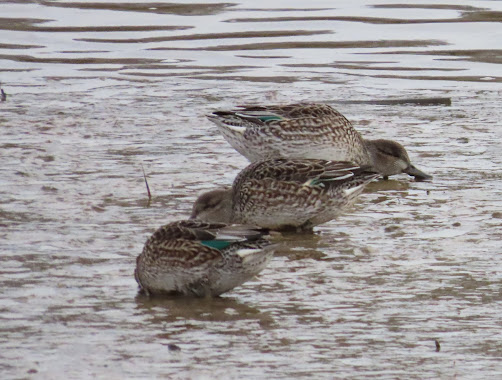
Three female TEAL

In the morning when I turned up to the Froize and the guide, John Grant, told us we were going to Hollesley Marshes, my heart dropped. But I was just there a month ago, I thought. I was hoping we would go somewhere off the beaten track to some place not open to the public. But I was pleasantly surprised despite all this. I think this had to be one of the best times I have been to the Marshes and that was something positive to take from the day, considering, how bad things have been recently for birds. Climate change is happening, its devastating our birds, and it wont be long before it affects us.

Wednesday, 2 February 2022

Minsmere - 26/1/2022

A BEARDED TIT, its handsome moustache denotes the bird as a male

The annoying thing about twitching is how unsatisfying it can be. Often the bird you've come to see appears briefly, or at a distance, and the only  way you know it is that bird is because someone told you it was. Sometimes you wait hours for a look only to get a blink and miss it view. Today's twitch was a LESSER YELLOWLEGS at Minsmere, and having been there for a week or so, the twitch wasn't big, a few birders moving in and out. But it was something I had to see, a destination bird, a rarity. This mislaid visitor from America was the first record at Minsmere for at least a decade, my first here and for Suffolk, a list tick at best.


A male TEAL feeding in front of East Hide

The bird was on the Levels, an area that begins just south of the Sluice and the Bushes, on and around Lucky's Pool. The Levels, an area off wet grassland, were flooded, and the bird spent its time on some wet land, annoyingly among some overgrown tussocks. I saw the bird in flight, with it white rump, and heard its call, and when I saw it in the open, which wasn't often, it resembled a redshank in shape and size. Two REDSHANK were nearby, which provided some useful comparisons.


This BEARDED TIT spent its time within a couple of metres of me, however photos were difficult as the reeds got in the way, interfering with the automatic focus.

As you can see from the photos the visitor from America wasn't even the bird of the day. Minsmere being Minsmere there were plenty of other birds about, enough to make a visit worthwhile without a twitch. Non-rarity bird of the day was a gorgeous male BEARDED TIT, who tamely stayed within a metre of where I stood, allowing me to admire it for an extended time. Although not a rare bird at Minsmere or on the Suffolk Coast, this bird is reliant on one habitat: reedbeds. And not just any reedbeds, but huge reedbeds. They are a pretty bird, all birds are this ginger colour, long tailed in shape, while the male also has a black moustache. Even when you don't see them you can often hear them, with their metallic "pinging" call, and there were at least three or four calling to this bird from deeper in the reedbed.


There is a tame ROBIN around the cafe

This being winter, there were plenty of DUCKS about, often dominating the birding scene. Twenty PINTAIL was a good record on South Scrape. Numbers of the usual duck on the Scrape were lower as flooding on the Levels had attracted more birds away to those areas. The Levels were full of WIGEON grazing the grassy areas. During winter a lot of ducks that turn up here for the season often pair up together before travelling back to their breeding grounds. Two male colourful SHOVELLER were competing for the attention of a brownish female, with a lot of head bobbing, and singing out their song, which is kind of like "jib jib". Shoveller are my favourite duck, the beautiful colours of the male, that extravagant bill, and when compared to the commoner ducks are strangely scarce.


A pair of male SHOVELLER displaying for the female's attention, which included a lot off head bobbing

Other than an off course American, there were a good range of other WADERS present, a bit of joy for a winter's day at Minsmere. A KNOT was a decent find, although I can see twenty thousand at Snettisham, Suffolk in general holds few of this bird, so seeing one is always a bonus. With the mild weather in the air, signs of Spring were beginning to emerge bleary eyed into the world with twenty AVOCET present, returning from their winter grounds, they will be looking to nest on the Scrape. Twenty DUNLIN were about, some SNIPE in grassy areas in front of North Hide, and five CURLEW on South Scrape were all seen. A GREAT WHITE EGRET was present on the Scrape, a bird I saw on my last visit, which has seemed to taken the area for a home and is staying put.


BEARDED TIT are common around large reedbeds, but are rare anywhere else

The sea as seen from Minsmere, can be quiet, but today there were a few goodies. A flock of 450 COMMON SCOTER (someone had counted them) were about, seen further down the coast, near to Dunwich, a long black line of black sea ducks. Several RED THROATED DIVERS were seen flying north, whist a GREY SEAL was also present, but apart from that there were just a few gulls.


Male WIGEON, this duck is quite common around the grassy areas.

All in all a solid winter's day down at Minsmere, with a rarity added into the mix. Places like Minsmere are so rare, so precious, yet even a place like this is at risk. Sizewell C is raising its ugly head, and will get the go ahead, even though its not needed, in fact stupid, but politicians want it so it looks like they are doing something, leaving a legacy at a huge cost.

Friday, 28 January 2022

Sculthorpe Moor - 18/1/2022

Male BULLFINCH, a gorgeous bird

Its sometimes the most low key of reserves that offer the best conditions for bird photography. Sculthorpe Moor may not be the most famous of Norfolk's nature reserves, but it provides some great views of birds and I left the place with a sim card full of pictures. When writing a blog its always heartening to be able to put up great photos, and its always the opposite when coming away from a good birding place, like Titchwell, and having no decent pictures at all (see previous blog).


Male CHAFFINCH

I visited Sculthorpe after a morning at Titchwell, and having time to spare, had a look. Now Sculthorpe Moor is usually a place you visit after somewhere else, not a go to reserve. It is a small site of valley fen somewhere in the heart of Norfolk, an important habitat that is rare in any size. But now the Hawk and Owl Trust have expanded the reserve and its now almost quadrupled in size. So what was an after thought of a reserve, is now a destination in its own right. However, although the reserve has been expanded in size, there are no facilities in these areas, so I wasn't able to see the new parts yet. But there's still time and hopefully I will witness the new lands in the future.


ROBIN

Bird feeders. There are lots of bird feeders at Sculthorpe. Every hide had several feeders stocked full of nourishing food. And there were lots of birds to feed on them. It doesn't take much to create habitat for our smaller birds. Overgrown areas are all you need. Sculthorpe has dry woodland, wet woodland, scrub and open fenland. A good mix of various habitats, which are simple to grow and full of birds. But in our tidy countryside all our messy areas have been cleaned up, and our little birds have declined. So its only on reserves like this, that this simple overgrown habitat remains and as a result the place is full of birds that are absent from our countryside.


GREAT TIT

There were decent numbers of the scarcer smaller birds present. The reserve has to be the best place I know, in East Anglia at least, for seeing BRAMBLING, which are usually seen from Volunteer Hide. The brambling is kind of like a northern chaffinch that breeds in the huge forests in the north of the world, which only winters in this country,  The Volunteer hide is extended into the sky, up in the tree branches, and here a bird table is literally centermetres from where you sit in the hide, providing amazing views. Also here was a pair of BULLFINCHES, such beautiful birds, with their scarlet chest and big black beak, they are common, but hard to find.


BLUE TIT

At another feeding site close to the entrance to the reserve, by the tool shed, a separate group of BULLFINCHES were present (this pair was a male and female, the other two males, this bird always comes in pairs), another BRAMBLING and also a MARSH TIT, all good birds. At Whitley Hide, a hide that looks out over the fenland, a NUTHATCH was present on more feeders.


LONG TAILED TIT

So its only a matter of time before Sculthorpe joins the premier league of Norfolk nature reserves, a destination reserve in its own right. This is good, because the more land protected for wildlife, the more wildlife there will be. However there is only so much a nature reserve can protect, change is needed in the wider countryside to provide more habitats for nature to survive. Hopefully we have turned a corner and now maybe see our countryside as something other than food factories, something natural rather than industrial.


Wednesday, 26 January 2022

Thornham Harbour & Titchwell - 18/1/2022

LAPWING in flight

The North Norfolk Coast is one of contrasts. Both wild and desolate yet at the same time a tourist honey pot site, full of wild nature reserves and tea shops and art galleries. Its also one of the best birding sites in the country, regularly attracting rare birds as well as vast numbers of the more commoner ones. Titchwell is the RSPB's reserve for the area, a mix of wetland habitat that's attractive to birds. Its good at all times of the year, but is well known for its migrating waders.


Thornham Harbour

I had some time off work, using up the last of my holiday from the working year, so I headed north of the border into the heart of darkness known as Norfolk. Yesterday I visited the Ouse Washes, see the previous blog page, so a trip further north Titchwell was in order. Usually at this time of year the reserve is good, but this time something was missing. I have been to this reserve several times in winter, and usually I have some good sightings, but not today, today was quiet, and has been for a while according to those at the reserve.

One of the creeks at Thornham Harbour

Before I went to Ticthwell, I stopped off at Thornham Harbour, a picturesque little spot with small muddy channels among a large expanse of saltmarsh. Here among some REDSHANK was a wintering GREENSHANK. Although a common enough bird on migration, greenshank are actually rare wintering birds, so this was a decent find. Further in the distance the calls of BRENT GEESE could be heard, with small flocks breaking into the sky, a bird I will see in larger numbers at Titchwell.


Resting LAPWING

And so it was on to Titchwell. The footpath at Titchwell is fairly simple to explain. Basically it is one path down to the beach from the car park and back. On the way it walks through various habitats, succeeding from woodland into reeds, into a freshwater scrape, to tidal lagoons, and eventually the beach and the sea. As a result with every different habitat there is an encounter with different species along the way.


Island Hide overlooking Freshwater Marsh

Freshwater Marsh is the focal point of the reserve, a large body of water with some newly created islands. DUCK numbers were low, but on the islands were a large flock of several hundred GOLDEN PLOVER and LAPWING. Five AVOCET were the first of the spring, this bird will start to nest here around March time in small numbers. A flock of BRENT GEESE were present, this black shaded bird is our smallest goose, the size of a mallard, they'll spend the winter here before heading off to Spitsbergan to breed.


Large numbers of GOLDEN PLOVER on islands in freshwater Marsh

After Freshwater Marsh the various tidal lagoons were quiet, the odd scattered WADER, like a REDSHANK, but little else. Tidal Marsh close to the beach had a red head (female) RED BREASTED MERGANSER present, a bird you expect to see on the sea, some distance away, not actually on the reserve, and close to, like this bird.


Resting TEAL

The path ends at the beach. As you walk over the dune tops you are suddenly blown away by the sheer scale of the beach, at Titchwell its huge. It stretches for miles in every direction. On the water's edge among the mussel beds were large numbers of WADERS. Little white SANDERLING, running like wind up toys along the water line, the slightly bigger and more stout KNOT, and the even more larger and more elegant BAR TAILED GODWIT, among all the other types of birds, such as OYSTERCATCHER, TURNSTONE, DUNLIN and more.


Parrinder Hide, a big glossy hide that's maybe a bit souless

On the sea, everything was quiet. Usually there is a decent assemblage of birds, but today there were just a couple of GOLDENEYE, just over the breakers on the sea. Not a diver, or a grebe, or any other kind of duck to provide any interest, which is a bit worrying.


More TEAL

Close to the visitor centre, before you take the main path to the beach there is a small path that detaches itself from the main footpath and meanders its way through some woodland and areas of fen and reedbed. In the trees were three BULLFINCHES two males and a female, which is a nice find, and maybe a first for me at Titchwell. Further along, Patsy's Pool, usually good for ducks, was practically deserted, which sums up the day for me.


GADWALL often feed with COOT. The coots dive, while the gadwall wait and take whatever the coot brings up. Sometimes this can really pee the coot up.

Now I look back on today's birding, it doesn't seem to be as bad as I originally thought. At the time, whilst I was actually at Titchwell, I just felt so underwhelmed, but maybe it wasn't too bad after all. Its just with such good reserves you  expect to see rare birds, and when they not there you feel disappointed. I know I'm repeating myself when I say the milder weather is resulting in lower numbers of birds turning up, but it seems to be a real problem for them. Climate change is creating little difference between the seasons and as a result there's less birds, less variety and the world of birds is becoming that much blander.