Saturday, 9 July 2022

Wolves Wood - 9/7/2022

PURPLE HAIRSTREAKS live high in the canopy, but this little fellow decided to pop down and grace me with his presence


With the year rolling into July, things slow down in our woodlands birdwise. The trees create an impenetrable barrier, while the birds themselves are so much quieter, going round to the business of raising families, with just a few half hearted territorial songs disturbing the quiet woodland air. And the extreme heat doesn't really add to the mix, birds hate intense heat. However despite one type of animal on the wing being subdued, now is the time to see the other, BUTTERFLIES, and especially those specialists of woodland habitat.


A ride through the forest

Wolves Wood is a nice chunk of ancient woodland situated on the Hadleigh road to and from Ipswich. Its a beautiful area of coppice, with rides, open sunny glades and ponds, which attracts a vast wealth of wildlife. Despite it being towards the end of the flowering season, the damp glades were full of MEADOWSWEET, MARSH THSTLES, MARSH BIRDS FOOT TREFOIL and SPEARWORT, providing a riot of colour. HONEYSUCKLE wound its way over and across the various trees, enlivening the open glades with its beautiful scent.


SILVER WASHED FRITILLARY


With such an abundance of nectar growing, Wolves Wood has a good population of BUTTERFLIES, with large numbers of the commoner ones, such as RINGLET, GATEKEEPER, and plenty of WHITES. But its to the scarcer day fliers that my attention was drawn, and there were some good numbers on the wing. SILVER WASHED FRITTILERY were common, a large orange butterfly, with black markings, an inhabitor of this kind of habitat, ancient woodland. The odd butterfly would drop down from the canopy to feed on a bramble fluttering from flower to flower. Stopping under an oak tree, I glanced high into the canopy, and seeing small dark butterflies, I was sure I was watching PURPLE HAIRSTREAKS. Lo and behold, one flew down to my height to pause on a leaf, wings closed, but eventually to open them to reveal its dark purple colourings. The last ancient woodland specialist today was a WHITE ADMIRAL, which I was only to get a brief glimpse of flying past me, maybe a metre above my height. Such joys on a hot sunny day.


A common LARGE WHITE, but just as beautiful

Just as beautiful as birds, butterflies are another indicator of the state of the countryside. In such well managed woodlands as Wolves Wood, there are huge numbers of them fluttering around, but away from areas like this, their numbers are small, just the odd one here or there. Gone are the days of clouds of butterflies, or even the large numbers I used to see on the buddleias when I was a kid. But all is not lost, as with sympathetic management, their numbers can bounce back fairly easily. All we need to do is to deindustrialise our countryside and let nature just breathe.

Tuesday, 5 July 2022

Cley Marshes - 30/6/2022


A nearly fledged AVOCET chick


Having visited the BEE EATERS at Trimingham near Cromer in the morning I had time to visit Cley Marshes nearby. Being Cley and the start of Autumn, migrating waders were the order of the day, birds that are much easier to find on the lazy return migration than in the rush of Spring.


MUTE SWAN

Its a strange quirk  in nature that the Autumn season begins in mid June, a time of high summer, but this is the time when WADERS start to return from their breeding grounds. There are different reasons for different species arriving back so early, for the RUFFS, the male has no part in raising chicks, or maybe for the SPOTTED REDSHANKS, they are mainly failed breeders. At this time of year the birds look resplendent in their breeding plumage, as for a few months over the summer these birds bedeck themselves in ostentatious plumages, in stark contrast to the greys and browns of winter. The birds were mainly located on the freshwaters scrapes, Simmonds Scrape and Pat's Pool in the centre of the reserve, and the brackish Arnold's Marsh. located just behind the shingle bank, from East Wall.


View of Pat's Pool, the main scrape at the centre of Cley

Perhaps the most flamboyant of waders is the RUFF, of which there were three on Pat's Pool. At this time of year the birds are males, and the birds are bedecked like the ruffs of Elizabethan nobles (which I am sure is how they got their name). Each male is unique and today one was outfitted with a natty black and white neck plumage. There was a SPOTTED REDSHANK as well, also on Pat's Pool, which at this time of year looks so unlike a common redshank, its nearest relative, its unbelievable. The bird was plumaged in jet black with white spots which give it its name. A GOLDEN PLOVER on Simmond's Scrape was black chested with a gold back, with three more on Arnold's Marsh. Brick red BLACK TAILED GODWITS were on the Serpentine near Arnold's Marsh with a GREENHANK. Slightly more dowdy, being a darkish brown and white was a GREEN SANDPIPER on Pat's Pool, and two CURLEW were on Arnold's Marsh. This was quite a good haul for the fluttering start of Autumn, but gradually the number of migrating waders will build up until it reaches its peak in late August and early September.


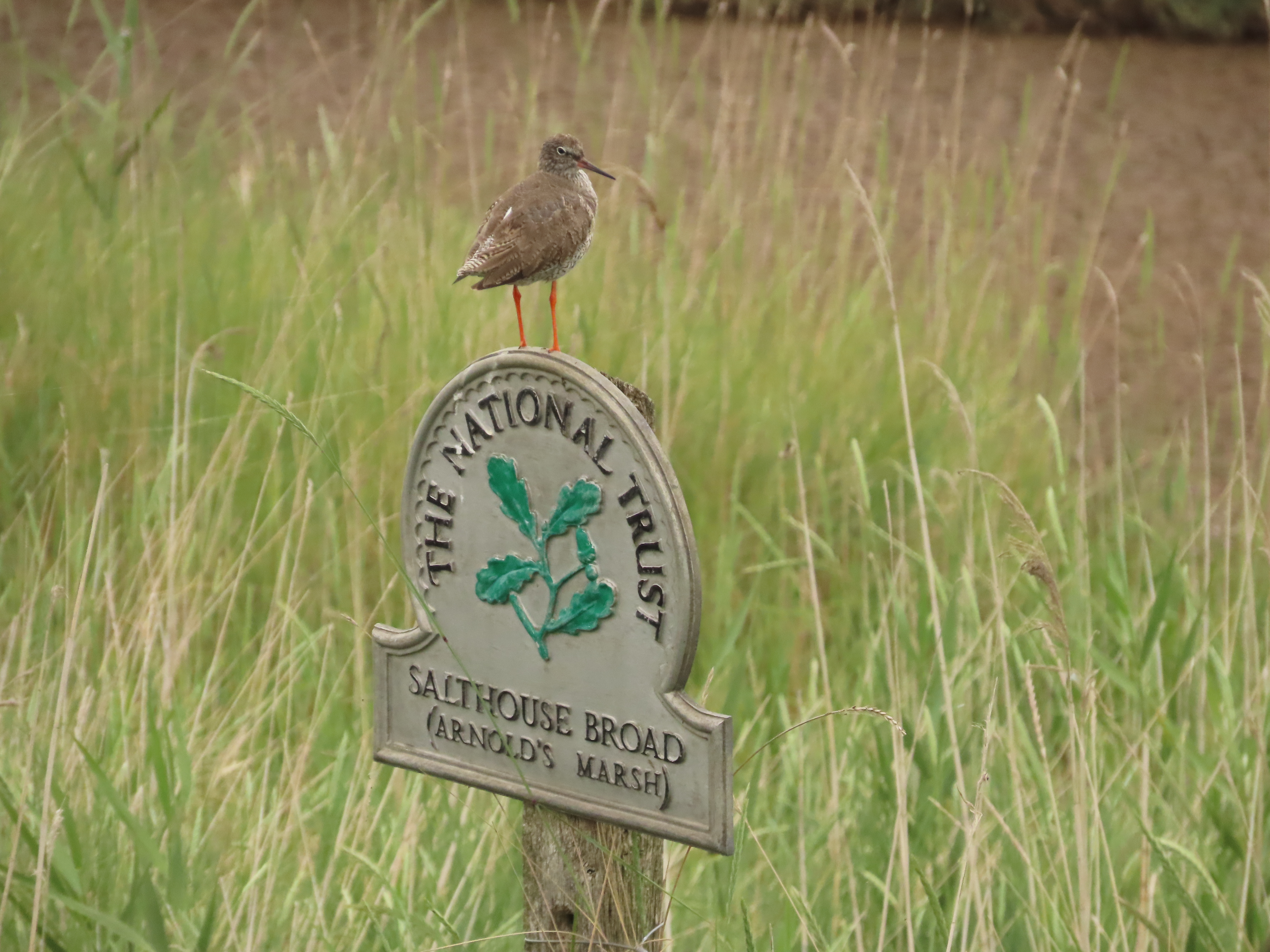
REDSHANK on the Arnold's Marsh sign

REDSHANK are pleasantly common at Cley, the rough grazed fields which make up a large chunk of the reserve provides plenty of home for them to nest in. Many chicks of various ages could be seen feeding round the edges of the various pools, and there would have been many more hidden in the grass. The adults, of course were very noticeable, and although they are only brown in plumage, they have the most haunting of calls, which really provides atmosphere to these marshes. A few very late LAPWING young were about and a small number of nearly fledged AVOCET young were on the various pools. There were also OYSTERCATCHERS and RINGED PLOVERS on the various pools and shingle stacks on the reserve.


SPOONBILL on Pat's Pool, with attendant LAPWING

Being North Norfolk SPOONBILLS were plentiful, with one resident on Pat's Pool, while at least five flew over. They can be easily separated from the similar sized LITTLE EGRET in flight, by the fact the spoonbill flies with its neck out-stretched, while the egret tucks its neck in like a heron. Apparently the spoonbills have successfully nested in land just off the reserve, I think in an area of trees near the start of East Wall. With so much destruction going on with our wildlife, its just so heartening to hear of a bird that has actually recolonised our country and increased.


AVOCET, Pat's Pool

GULLS and TERNS don't really nest at Cley, but they do in other places across the North Norfolk coast, but there was still a decent selection on show here today. Five LITTLE GULLS were on Arnold's Marsh, with a flock of 70 non-breeding SANDWICH TERNS also there. A flotilla of five LITTLE TERNS flew in from the sea and flew east along just behind the shingle stack, its always a delight to see this delicate bird.


BLACK HEADED GULL

DUCKS were relatively absent from Cley with various broods of SHELDUCK of different ages the only breeding record. Some TEAL had returned to spend the Autumn and eventually the winter here and a WIGEON was on the North Scrape, but that was it really.


SWALLOWS were nesting in the hides

The summer months are a time of intense energy for our smaller birds, for whom its still the nesting season. The Birds are busy raising families in the bountiful landscape that make up the Marshes. In the various hides that look over the scrapes SWALLOWS were nesting within, flying in and out of the open slats, returning to nests high above your head right as you watched the birds outside. BEARDED TITS could be heard in the extensive reedbeds, their metallic "pinging" call could be heard in snatches as the birds would fly between reed stems providing brief glances. REED WARBLERS were very plentiful, seen allover the reserve, this plain brown bird could be seen going to and fro from their nest embedded deep within the reeds.


MALLLARD ducklings

As usual it was an excellent couple of hours spent birding the splendiferous birdwatching mecca of Cley Marshes. Its so good just to check into these places to see what's happening in this neck of the woods. North Norfolk is such a great location just to visit really, at any time of year there is always something of interest to see. For mid June what I saw was better than expected, although the birds recorded were typical of early Autumn waders, you don't often get to see them all at once in the same place. 

Saturday, 2 July 2022

BEE EATERS at Trimingham - 30/6/2022


If you make a list of the most beautiful of European birds, surely the BEE EATER must rank highly. Combining in all the colours of the rainbow within their plumage, these are exquisite birds to look at. They are common enough birds in the warmer parts of the continent but are fairly rare in the UK, appearing in the summer months usually on migration in late May. They are even rarer nesting birds with maybe half a dozen records in the last few decades. So it was a surprise when seven birds turned up at a disused quarry near Cromer at the start of June.


One of the most stunning of birds to see in Europe, like a flying rainbow

BEE EATERS are colonial nesters, which means they can only nest if others of their species are around them, and they like loose soil which means they usually nest in quarries. The last nesting attempt was in Nottinghamshire in 2017, and I wasn't able to go, being too far away and having too many commitments. So with news of the birds turning up in a close location, I had to have a look. Rather than keep the nesting site secret, the RSPB decided to open up the site to visitors, with a car park and viewing area, allowing people to have a look at these gorgeous birds.


The overgrown, disused quarry where the bee eaters had taken up residence. There was nothing particularly special about the quarry, there are hundreds like this throughout the country.

The quarry was an old sand one, overgrown with scrub, with some loose areas of cliffs which the bee eaters were nesting in. It was set within a nice area of rolling countryside, with hedgerows and copses dominating the land. A small colony of SAND MARTINS were present, with LINNETS, WHITETHROATS and singing SKYLARKS also around.


The BEE EATERS, centre two birds on the top telephone wire, were never close so unfortunately I didn't really get any good pics

Seven bee eaters were present but only five were in view at one time. The birds were not close, they were mainly perched on telephone wires in the distance, and you needed a telescope to see their resplendent colours. The birds would often launch into the air to catch a large insect on the wing, which they would gobble down when they landed again. At one point one of the pairs was seen copulating so its hopeful these birds might stay to nest. Time will tell if the birds are successful in their nesting attempts, but with global warming making the temperature of our country more accommodating, the nesting attempts will only get more frequent.

Tuesday, 28 June 2022

Lackford Lakes - 21/6/2022

BLACK HEADED GULL and young, Long Reach lake

Among the pantheon of great photography reserves, one site sits above all others in Suffolk. Lackford Lakes is by far the best place to visit if you have a need to photograph birds. No matter if the birding is lacklustre, as it usually is at Lackford, I always return with some decent shots, and when you're writing a blog that's a god send. However although Lackford is a good reserve, its not really the place to go and see the rarer birds. But despite this, the site is a flagship reserve for the Suffolk Wildlife Trust, and is very popular with birdwatchers, experienced or novice.


Pair of TUFTED DUCK on the Slough

Being a hot day in June, things were pretty lazy, as you would expect. The usual water birds of Summer were present with nothing unusual, the sort of out of bird I hanker after. Lackford Lakes are a series of large lakes, man made but natural in appearance, with reed or tree bordering the water. The lakes are reserved for wildlife, with no fishing or any other kind of disturbance, which is great when compared with some of the fishing lakes I visit locally where wildlife is seen as something to be destroyed, not protected.


Female MALLARD

The Slough

The central lake is the Slough, which has a mixture of islands and large areas of reeds, it seems to attract the most birds at Lackford. As with most lakes there were a couple of pairs of TUFTED DUCK, and small flocks of moulting GADWALL hanging around the water. A SHELDUCK brood of one single duckling was present. Away from the breeding birds small numbers of LAPWING were present, and believe it or not, these birds are return migrants, its a strange quirk of nature that Autumn migration starts in mid June, when it feels like high summer. Lapwings nest early, and finish raising young by mid June, but these birds will be failed nesters, or those that didn't manage to find a mate, so are the first to return. A CUCKOO was calling and I eventually saw it in flight, the best time to see them is when they stop singing, which means they are moving about. Throughout the reserve today the sound of 'cuckoo cuckoo' rang out across the site, creating such a great soundtrack to the day. A male MARSH HARRIER flew over the hide, quartered the reeds before settling down on a bale of reeds to rest awhile. They are a relatively new nesting bird on the Lakes, its a testament to modern conservation efforts that this bird has increased to so such a large population from just a single pair in the 1970s.


Dinghy on the Sailing Lake


Moulting SWANS on the Sailing Lake

A feature of the lakes in mid summer is the flock of moulting SWANS present on the Sailing Lake. This year however, numbers were around half what they usually are, with only thirty birds present on the water. The nice weather had enticed some sailors out with a few dinghies on the water, this is the only lake in which there is any sailing, every other one is reserved for wildlife. 


Pair of nesting GREAT CRESTED GREBES on Long Reach lake

Long Reach lake

Lackford isn't particularly that bountiful for breeding birds, for some reason despite all the plentiful habitat there isn't the sort of birds you think would be present. The usual birds that nest on gravel pits were present. A pair of GREAT CRESTED GREBES were nesting on Long Reach with another brood on Plover Lake. The young birds are called "humbugs" for their stripey heads, they have the nice habit of riding on their parent's back, a little head popping up from the adult's feathers. A paltry single brood of COOT were present on the Slough, and two broods of SWANS again on Long Reach and Plover Lake. A sweet brood of five tiny LITTLE GREBES were present on Long Reach, with an older fledged bird on the Slough.


COOT feeding young on the Slough

The various rafts around the lakes, I think put out for nesting terns, were of course taken over by BLACK HEADED GULLS, with various oldish chicks begging their parents for food. A pair of COMMON TERNS did manage to find room to raise two nearly fledged young on a raft on Hawker Pool.


Nesting GULLS on Long Reach lake

Being high summer the smaller birds were a lot less noticeable today, as they were busy raising families, the parents had no time to stop for me, coming to and fro from deep cover in some hard to find nest. A KINGFISHER was briefly on Wilson's Flood which flew across the lake before perching distantly at the very back on a tree. Plenty of REED WARBLERS were present around the lake fringes often coming and going from the nests, providing snatches of views before disappearing again.


Friendly ROBIN having a dust bath

So a not a particularly great day for  birds but that's not the point really. It has been a month or so since I've done any serious birding, and it was just so good to get out into such a peaceful, tranquil place. The face of birdwatching is always about that pursuit of the rare bird, the twitcher, but sometimes its just good to go out to bird for birding's sake. Anyway I should have some more free time soon and should be able to get out more, and of course I shall write about them on this blog.

Tuesday, 14 June 2022

Spring on the Local Patch - 2022


The countryside can look so beautiful at this time of year

Its been a fairly underwhelming Spring with nothing remarkable noticed on the area of farmland I call the Local Patch. Just wondering round the arable fields, patting the occasional horse on the head, I notice how little wildlife there is in the general countryside. Even in the relatively short time I've been visiting the Patch, birds have been declining. This Spring was marked by the complete disappearance of SWALLOWS, when there should have been small flocks quartering the Suffolk Punch Field and the Reservoir. Time will tell if its just a blip or whether our wildlife is really disappearing at a massive and shocking rate.

As with everyone, leading a busy life I wasn't able to visit the Patch as much as I wanted coming and going every couple of weeks, so this isn't as comprehensive a report as I wanted.


The road leading from Rise Hall

Weather

Spring, like last year, was dry, following on from the driest Winter on record. The Pond had dried up and the Stream was running at late Summer levels, barely a trickle at times. But unlike last Spring it was hot, with some really scorching days. There would be the occasional rain, heavy downpours for a random day or so, but would have little effect, barely wetting the hard ground. 


The Reservoir

Despite having had none all winter, on 31/3 we had a light snow storm, as well as heavy hail. Nothing hinted that this would happen, nor would we have known as we had hot weather before and after. Is this climate change, who knows, but this combination of hot weather followed by cold followed by hot has deadly effects in Spring. Newly emerged insects may die off affecting bird populations, birds busy starting to nest may be caught out and stop. As always if our wildlife was at normal levels they would recover, but with our countryside so depleted of wildlife, it seems to be another nail in the coffin.


The Stream, a ditch really. Water levels have been low this Spring with the dry weather, usually the slabs are well covered by water

Unusual Sightings

Although it was a quiet Spring there were several unusual sightings. I had one first for the Patch in a nice male REED BUNTING by the Reservoir. Its an unusual sighting here given the fact there are no marshes on the Patch, let alone any reeds to attract this species. I only ever get a couple of new Patch ticks a year, so this record was something to be savoured. A RED KITE flew over my garden on several dates, which I'm guessing is the same bird, a great bird, that has made a massive comeback in this country due to reintroductions, and if one has made into suburban Ipswich, then they truly have cornered everywhere. Perhaps the strangest sighting this Spring, was on 17/3. While waiting for a bus on Shakespeare Road, a WOODCOCK flew over me heading east just over the houses. Seeing the bird, in a built up area, miles from the nearest wood it would call home, was just so amazing and just confirms why even for a man who has birded all his life, there are always surprises. The local bird recorder told me there are only single sightings of this bird in Ipswich at this time of year, which made the sighting so much better.


DANDELION grow in profusion in the set aside of First Field

Rede Wood

On the very, very outer limits, lies the only true area of woodland on the Patch, Rede Wood. This is an ancient wood, a land that has been covered this way for at least five hundred years. Ancient woodlands are like the cathedrals of our wild countryside, awe inspiring, and just so precious, something that has survived against all the odds. Visiting this wood makes it just so great to get away from it all, to dose myself in bird song and breathe in the clean oxygen replenished air. It is an area of coppice, with the trees cut back to a stump every few years, creating a scrubby effect, with a few standard trees left to grow tall.


Coppice stools at Rede Wood, with the green DOG'S MERCURY growing underneath

Having a nice scrubby, brambly, ground layer woodland plants weren't growing in profusion, growing in the scattered open spaces. When I visited on 26/3 several flowers were starting to appear, woodland flowers grow earlier than grassland ones, because they have to time it right when there are no leaves on the trees, to maximise the sunlight they receive. WOOD ANEMONES, PRIMROSES and DOG'S VIOLETS were all out in bloom. Although not the most flamboyant of flowers, DOG'S MERCURY was out in profusion colouring the ground beneath the coppice stools a bright green.


PRIMROSE

WOOD ANEMONE

Being a fairly small wood Rede Wood doesn't harbour any of the real woodland specialist birds. Common birds of trees and bushes were plentiful, with a GREAT SPOTTED WOODPECKER drumming and a TREECREEPER seen. A pair of BUZZARDS nest in the woods, a second pair of the Patch, aside from the Suffolk Punch Field birds, which shows just how successful these birds can be if not hunted to extinction as they were in Suffolk. Its amazing to think that at the dawn of the millennium there were no breeding buzzards in Suffolk at all.


The trees of Rede Wood tower over the bramble strewn floor

Firsts for the year.

One of the thrills of Spring is finding the first of the year, the earliest date that a bird has returned to the Patch from their wintering grounds. There is usually a small trickle to begin with in March before April opens the floodgates and migration is in fall swing, before things start to calm down as you get into May.


Hawthorn flowers

The first migrant back is the CHIFFCHAFF, who returned to the Patch on the 14/3, and it wasn't long before their 'chiffchaff' song could be heard from every area of tree cover. BLACKCAPS are always usually the second back, with one on 7/4, around the usual time, and although not as common as chiffchaffs, there were soon plenty of birds singing their scratchy song from the tall, scrubby areas.


WREN like to nest in thick areas of cover, like patches of ivy

WHITETHROATS were pleasantly early this year, the earliest I've ever seen on the Patch. A bird was singing from a hedge on First Field, a place where ever since I started birding here nearly ten years ago, a bird has been on territory every year. Of course its not been the same bird, they don't live that long, but maybe birds that have been reared here have returned to breed in the place they were born. Its amazing how such small things can have so complex understanding within them. The bird I first recorded on 14/4 was only a day later than the first record of the year for Suffolk, so if I had turned up a couple of days earlier, I might have had the first record for the county. On a different note my first LESSER WHITETHROAT didn't show until 24/5, a very late date, although I hadn't been looking in the place it was singing from for a while.


The Prairie Field had been planted with rape this Spring

As I have previously stated SWALLOWS never turned up, but the first SWIFTS were a bit late on 10/5, with only small numbers hawking for insects over the fields. Its a bird that is sadly slowly disappearing over the skies of Ipswich, which is a shame because I love just looking up from my garden to see them dashing around the skies high overhead.

Other Birds

There was the usual cast of birds, old familiars who kept me company on my rambles around this area of countryside. The pair of BUZZARDS that nest in the woodland of Suffolk Punch Field, the many SKYLARKS rising over the arable fields in song, the flocks of LINNETS and GOLDFINCHES chirruping by in flight. YELLOWHAMMERS now seem set for extinction on the Patch, with few birds returning to nest this year. It wasn't too long ago when there were flocks of fifty birds wintering in the area, why they have crashed so quickly, is a mystery to me.


For the first time in years MALLARDS have nested on the Reservoir

For the first time in years MALLARDS have nested on the RESERVOIR, with a nice brood of little ducklings swimming around with their mother. For a long time there was a resident flock of eight GREYLAGS, who set up home next to the Pond, but for some reason vanished at one point. A sighting of four birds had me in hope they would return, but they didn't stay long, and had disappeared by the time I came back.


Someone had left behind their wooly hat

Every birder has their local patch, that crap piece of land that for some reason they are loyal to, a place where they see bugger all but still return to day after day for more. As you can see my patch is pretty rubbish for birds, yet I come back, god knows why. Yet I know this area like the back of my hand, I know all the changes of the seasons, I know when birds come and go, wax and wane, and I lament the ones we lose. And its only from people like me on patches like this that we really know the shocking loss of wildlife we are witnessing in the countryside on our watch.

Saturday, 4 June 2022

Snettisham - 17/5/2022

Pair of OYSTERCATCHERS

One of the greatest wildlife spectacles of this country we inhabit is the wader roost at Snettisham on the Wash. On a very high tide in October you can witness maybe a hundred thousand birds swirling in murmarations, as they fly over your head as the incoming tide covers the last of the mudflats. As there is no room on the estuary as the tide rise, they all fly over to land on the gravel pits next to the estuary, where thousands of birds pack into a tight place jostling for position. However in mid May, when most of the birds have gone to the far north of our world to nest there were only a few thousand birds present today, creating nothing much of a spectacle.


BLACK HEADED GULLS nest anywhere they can

The wader spectacle was late in the day allowing me the day to spend at Pensthorpe (see previous blog). As is usual for a wader spectacular, there were plenty of people present, making an occasion of it. What was unusual for a spectacular, was that the weather was nice and warm, instead of the freezing cold you would get in October. 

The flocks of waders were in their thousands, not their hundred of thousands

Its a long walk from the car park to the reserve proper, walking past fishing pits and then the first of the gravel pits and shore bungalows. Its only when you get to the final gravel pit that things become interesting. There, thousands of BALCK HEADED GULLS, MED GULLS, COMMON TERNS and AVOCETS cram into the islands on the pit, a great noisy mass of white. Then all of a sudden pandemonium would erupt as a GREATER BALCK BACKED GULL would swoop in and steal an egg. Its by this pit where you witness the spectacular.

There were a few wader murmarations

An offshoot of the season producing fewer birds, is that the birds present are nattily attired. In the brief days of summer the WADERS all put on some stunning plumage. In the ascendency were GREY PLOVERS, with  their black belly and silver back; brick red KNOTS; further brick red BARWITS; DUNLINS with their little black bellies; SANDERLING in their dirty purple, all gorgeously coloured. Also about was a SPOONBILL sieving its bill along one of the estuary creaks, an iconic bird of the Norfolk Coast.

The tide would come in and cover all the mud forcing the birds into ever tighter corners

The tide comes in quickly and before you notice it its caught up with you. Despite the season there were still plenty of birds about on the mud and the tide line. The birds gradually moved in with the tide, and by the time the water had fully come in there were a couple of murmarations, knots of birds swirling in the air in unison, but the numbers were low. The birds hearts were not really into it as they dream of departing for northern climes.

Rather than use the gravel pits the birds tended to fly somewhere else.

So a bit of a disappointment in that the spectacular was fairly small. It must have been a drag for those non birders who turned up to see it, expecting to witness something grand. However I have never been to Snettisham in a warm month, so it was interesting to experience the place when I don't have to cover up in layers and shiver my nuts off. But the year still carries on and it wont be long before we hit the colder months and the waders start to arrive en mass for their winter and we can once again witness this spectacle at its most spectacular.