Thursday, 11 August 2022

The River Gipping Lakes - 30/7/2022

Pair of CANADA GEESE in the cow field between Shamford Mere and Causeway Lake. Look how brown the grass is from the recent drought

With some time to kill on a nice quiet Saturday, I decided to visit one of my local patches, some of the lakes that stretch along the River Gipping. I don't visit this area often enough, the last trip here was in April, so it was time I had look. The area is good to reach, as it flows along a bus route, so I can visit different areas hassle free. I started with Shamford mere and Causeway Lake, near Baylham, travelling south to Barham Pits near Claydon, a journey of several miles.

Shamford Mere and Causeway Lake

These are a pair of lakes along the middle part of the River Gipping that stretches between Needham Market and Ipswich. They are small bodies of water, no more than four or five acres in extent, so aren't huge, but being fairly off the beaten track are not that disturbed so often attract some wildfowl.


JAY on the fence along the Gipping

The star bird was at Shamford Mere with an eclipse male RED CRESTED POCHARD on the water. This is mainly an introduced species, although I have seen birds I'm certain are wild. Being a bird that likes gravel pits they are quite rare in Suffolk, I have only a couple of records from this  county. Also about were eleven TUFTED DUCK, this lake is usually the best in the Gipping area for this bird, they'll be moulting ducks going into eclipse.


RED ADMIRAL butterfly

Further along the river, just beyond a cow field, is Causeway Lake, a similar body of water, but this one is fished, although no one was about at the time. Again there were some moulting wildfowl, with twenty MUTE SWAN, and thirteen COOT about.


The Greta Blakenham weir, an unnatural barrier to wildlife on the Gipping

Following Causeway Lake it was a short walk down to Barham Pits, along the river Gipping. Because of the drought we are presently experiencing water levels were low, the weirs along the river barely flowing over, a good reason to get rid of them and let the river flow naturally again.

Barham Pits

The bottom lakes along the Gipping are Barham Pits a series of fishing pits, much disturbed and with not many birds. Being close to where I live I visit them often, but haven't really seen anything of interest there.


Female TUFTED DUCK on Barham Pit B

On the top lake, Meadlands, GREAT CRESTED GREBE had successfully raised a family, with some old fledged young hanging about. Below that, on the exotically titled Pit A, COOT had successfully raised a family. Pit B, the largest lake along the Gipping, held thirteen COOT and two TUFTED DUCK. Pit B held three pairs of GREAT CRESTED GREBE this year, a pair with two young being the last of the season.


Barham Pit A

As always local patch birding is hard work, a lot of time for not very much. But being my patch, I feel its my responsibility to keep visiting, as I'm pretty much the only person who will, I have never met any birdwatchers here. Hopefully this will result in some sort of record for the area, something important for the time I put in. I hope.

Tuesday, 9 August 2022

Beadnelle Bay - 21/7/2022

Male STONECHAT


The coast of Northumberland has some nice attractive walks and Bedenelle Bay with its combination of long sandy beaches and rocky breaks inbetween, is very picturesque. Although it doesn't have the rugged cliffs of other parts of the coast there was more of a refined beauty to the place. Its also a good place for birdwatching and I saw a lot decent spots including a new (sub)species.


A lame KITTIWAKE on the beach, hurt or avian flu, who knows? I'm always unsure what to do with them as wild birds carry lots of diseases.


I took the bus to Beadnelle, north of the Bay, got lost and eventually found my way south. The beach of the Bay spreads out long here to distant rocks. As it was busy with people nothing much showed for a long while. The only bird I did find was quite disconcerting, a KITTIWAKE on the sand, a bird that couldn't fly, and was obviously in distress. As it was a wild bird, I didn't want to touch it, but it may have had avian flu, which has decimated the bird colonies of the coast here. I made my way along the beach, until I hit a river channel, cutting the beach in half and I moved into the dunes to cross it. The dunes were full of colour, the rich purple of BLOODY CRANESBILL, and the delicate blues of the HAREBELL. There were many STONECHATS among the dunes, with a decent number of young ones meaning that it seems there was a successful breeding season for them, always such characterful birds, they are always happy to perch at the top of some bush. On the other side of the river, laid my target, the TERN colony that resides there.


The dunes were a riot of colour, the delicate HAREBELL providing a delicate blue.

A small reserve, owned by the National Trust looks over a TERN colony, just off the beach. There was a target bird I was after, an AMERICAN BLACK TERN which had spent a large chunk of the summer here, associating with the other tern species. Surprisingly it was very easy to find, resting with the ARCTIC TERNS on the beach. It was much smaller than the arctic's with a fully black body, but was moulting so had white around its face. Black terns have always been a favourite species of mine, when I used to birdwatch at the local Tring Reservoirs, they were always the spring migrant I wanted to see the most. The American variety is only a subspecies, but will be what they call an armchair tick, as in the future it may be declared a species in its own right. This was my first record of this subspecies, and a delightful one to have.


ARCTIC TERN, there was a large colony of them at Beadnelle Bay

The ARCTIC TERN colony seemed to be going strong, nesting in the marram grass just behind the beach. A dedicated team of six rangers looked after them, mainly on naughty dog patrol, as although the colony is roped off, it can still be fairly easily entered, by unwitting beach goers. This quiet part of the beach was a good spot for sand loving WADERS, with over forty SANDERLING, and good numbers of DUNLIN and RINGED PLOVER, not having to worry about any disturbance. 


Embleton Bay, with the runs of Dunstanburgh Castle in the background

I walked down until I hit the south side of the Bay, and the village of Low-Newton-by-the-Sea, and moved inland to a little wetland, just below. By a shallow flood in a field a pair of AVOCETS were busy guarding a brood of four nearly grown youngsters, while a YELLOW WAGTAIL fed on the muddy edges, nowadays a difficult bird to find. Further down, a hide overlooked Newton Lings, a small lake, but nothing was of interest. Walking south of the hide, there was an extensive wetland, overgrown with masses of MEADOWSWEET, fields the colour of rotten teeth, interspersed with the odd purple of PURPLE LOOSESTRIFE.


Newton Lings wetlands were overgrown with creamy MEADOWSWEET, PURPLE LOOSESTRIFE, and ROSEBAY WILLOWHERB on the higher ground at the back

I hit Embleton Bay, another large stretch of beach, sand flowing all the way to the remains of Dunstanburgh Castle on the far horizon. From here I went inland, following the path to Embleton to catch the bus there. The large fields had recently been harvested, the barley sorted into bails. It was whilst walking along one of the footpaths that I flushed a GREY PARTRIDGE, another bird that used to be a quintessential bird of the countryside, that is now so very, very rare. 


Harvest time in the interior

My last birdwatching walk of my holiday in Northumbria, and a lovely one exploring some beautiful countryside. One of the things I love with birdwatching is that it gives the excuse to visit these places that are so off the beaten track, places that feel so virgin, that feel like I am the first to ever walk them. I shall miss this area of the country, as I don't know when I will be back next, but I know I shall have many good memories of Northumbria.

Thursday, 4 August 2022

Hauxley - 20/7/2022


LAPWING are common at this time of year, Autumn migrants in July

Being the flagship reserve of the Northumberland Wildlife Trust, the lake that forms Hauxley provides some good birdwatching, combined with the comfortable visitor facilities to pamper the birder. It was nice to just sit in the café and look out on the lake and watch the birds while having a coffee, something fairly unusual in birding. I spent a couple of hours here, and it was alright, its just that this time of year, mid July, isn't really the best for any kind of birding. Its an inbetween time, summer has faded and autumn has yet to get going, creating a fairly unremarkable period.


The lake which is the focal point of Hauxley

The reserve is centred around a large lake. Formed from open cast mining the body of water is situated a mile from the coast. Fairly shallow, several islands have formed in the middle, creating an attractive place for birds. The lake is still young so hasn't developed any surrounding vegetation, like reedbeds, so when this develops, the place will become more attractive to birds. There are a series of hides that look at various points of the lakes, providing comprehensive viewing . Other habitats include scrub and hay meadows and the rough grassland which abounds around the reserve was species rich, creating a colourful carpet of flowers.


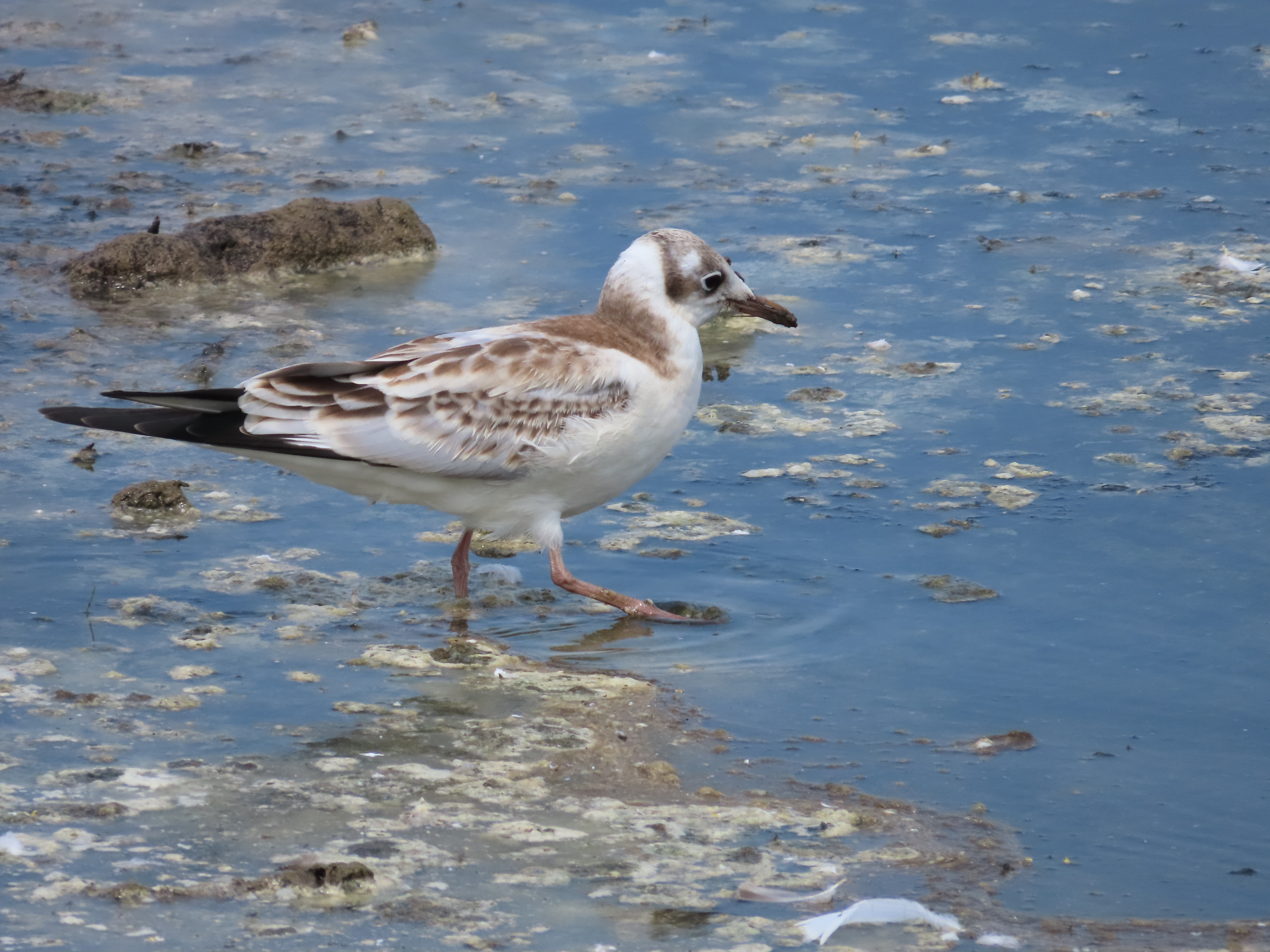
A fully fledged BLACK HEADED GULL from this year's crop

As you would expect for a lake there were a few WILDFOWL about. Apart from the hundreds of GEESE present, there were a few DUCKS. POCHARD, SHOVELLERS, GADWALL and TUFTED DUCKS were present in small numbers. TUFTED DUCKS are late nesters, with youngsters not seen until the end of June, a month later than most other ducks, and two broods were seen today, of one and two ducklings, they are common nesters on lakes like this one. Two WIGEON may be summerers or early wintering birds.


The visitor's centre has a nice café which overlooks the lake

Having not developed vegetation the lake had plenty of mud, which attracted a few WADERS. A GREEN SANDPIPER was present, with four or five COMMON SANDPIPERS, about, related birds but very different once you get your eye in. Forty DUNLIN were also present around the lake, and there were also small numbers of REDSHANK, OYSTERCATCHER and CURLEW.


GEESE have achieved plague proportions on some of our bodies of water

A juvenile STONECHAT may be a local breeder as they nest in decent numbers on the nearby dunes, and a single TREE SPARROW alighted out of the hedgerow in front of me, but in general it was a bit too hot, and a bit too out of season for the smaller birds.


PEACOCK BUTTERFLY

Bird flu has hit Hauxley hard, and dotted round the reserve were the remains of dead birds, what mainly looked like gull, their corpses left to rot away. Its a real shame, as our birds are under so much pressure anyway, from habitat destruction, among other reasons. At a point where a lot of birds live in isolated populations in the country, reduced to one or two places, bird flu could wipe out populations that may  never recover.


More views of the lake, there really wasn't much to photograph today

It was as good as you would expect from the off season, on a swelteringly hot July day, so I can't really complain. This is one of a series of reserves that protect wetlands formed from open cast mines that stretch down the coast. Unfortunately I didn't have the time to visit them all, but Hauxley was a good introduction to them. Maybe in the future I can visit in a time when there are plenty of birds, like winter or spring, and have the opportunity to have a more in depth look.

Tuesday, 2 August 2022

St Abb's - 19/7/2022

This OTTER broke through the green water of Eyemouth Harbour, to appear literally a metre from where I was standing.

The rugged cliffs of Northumberland stretch far north, over the border and into Scotland. St Abb's is a series of towering cliffs rising from the sea, and are protected for their sea bird colonies, as well as the surrounding marine environment. The sea bird colonies that reside here are smaller than those at the Farnes, and combined with a lateness in the season, it was fairly quiet. I pretty much thoroughly explored the area, taking a boat trip around the cliffs, and then later on in the day walking them.


The cliffs are stained white from guano, the droppings of thousands of birds

I booked a boat trip for the morning, one that went from Eyemouth Harbour, out to sea and all the way to ST Abb's cliffs. It was for an hour and a half with on board commentary, and space to move. While waiting for the tour to start, hanging out in the harbour, I  sported the distinctive shape of an OTTER, which promptly disappeared. While looking round the boats, a head broke from the depths of the green water, and suddenly an otter poked out, right below where I was standing. I managed to get a few photos, before he disappeared, I didn't have to zoom in to catch a picture of his face. Not a bad start, and considering it was a busy harbour, with lots of people and boats around, pretty magical.


GANNETS have recently colonised St Abb's Head

The boat headed out of Eyemouth, and to begin with the landscape was nothing particularly interesting, as we passed the created "fishing" village of St Abb's. It was only after this point that the landscape began to change, as the cliffs force themselves out of the sea, to create some truly breathtaking scenery. The cliffs go high, stained white by the bird's droppings, with many numerous stacks and outlying islets. Created from volcanoes bursting forth from the molten layers below the Earth's crust, they were truly grand. The sea around these cliffs are now declared a marine reserve, meaning the seas the birds live on is now protected, and maybe fish stocks will recover enough to be able to support them again.


Sea stacks form along the cliffs

Bird-wise things were fairly quite with just a few GUILLEMOTS and RAZORBILLS about. Around June time they pile into these cliffs in their thousands, but today, at the tail end of the season, only a few birds were about. All the usual supporting cast were also seen. They were mainly KITTIWAKES flying around. These are our true "sea" gulls, coming to land only to raise young on our sea cliffs, before disappearing out to sea for the rest of the year. They are a truly understated bird, their clean, lack of distinctive plumage makes them easy to identify. SHAGS have a long nesting season, and there were still a lot of birds about, usually hanging round on the rocks on the water's edge. FULMARS are like gulls, but aren't related. They fly with stiff, unbent wings, and were less common. And finally there were plenty of GANNETS, a few birds have started to nest at St Abb's, having turned up last year, but there were still plenty of birds coming here from further up the coast. When flying together, they fly in a squadron, one bird flying after another in formation, making quite a sight.


This GREY SEAL followed us, hoping we were a fishing vessel that would throw out a fish for him

After taking us around the cliffs, the boat headed back to Eyemouth. On the way back a HARBOUR PORPOISE broke through the water, giving us a brief glimpse of its fin. As we headed into the harbour, a GREY SEAL followed in our slipstream, thinking we were a fishing vessel, hoping we would throw a fish out to him. It looked an old boy, head full of scars, so was maybe to infirm to catch his own fish. We disembarked at Eyemouth, and I headed north to walk the cliffs that make up St Abbs' National Nature Reserve.


You can really see the guano here. In June this cliff would be heaving with thousands of birds

The cliff top path that makes its way over the undulating landscape of St Abb's is truly breathtaking. Its a moderate walk, I mean its steep, and  there is a lot of walking uphill, but its not far, only an hour to the furthest part of the walk, the lighthouse. The path takes you high before making its way down to a small beach, before heading up again. Being advertised as the warmest day on record, the number of people walking was low, which suited me fine. Despite the heat, there was an offshore breeze and walking was fairly comfortable.


CORMORANT among the SHAGS. The cormorant is much bigger and black. Adult shags are smaller and green. The brown birds are young shags.

As I have stated before the number of birds on the cliffs was negligible, with just the usual rabble of late nesters hanging around. A tiny loch, long and thin, hemmed in on all sides by high ground, called Mire Loch, held a small number of TUFTED DUCK and LITTLE GREBE, while the COOT family there were either a second or third brood at this time of year. It was strange to think I saw a lesser scaup here last year. The loch is surrounded by a thick growth of reeds, where I saw a few BUNTINGS and WARBLERS. From the furthest point you can either walk back inland or head back down the coast path again, I chose the latter, because the views inspired me so much and I wanted to experience them again.


Some rugged scenery from St Abb's

Maybe its something we take for granted but there are some truly breathtaking areas of our country. Add in with this breathtaking scenery an area bursting with life, areas that are truly fertile grounds for nature. And although being the end of the season things were fairly quiet, it still made up a truly grand day. If you're sitting there reading this blog, then make the effort to visit some place wild soon. It will do you the world of good.

Saturday, 30 July 2022

Farne Islands - 18/7/2022

PUFFIN!

Where would a holiday blog from Northumbria be without a post about the Farne Islands. Craggy islands that lie a few miles off the coast, the Farnes strut around the sea with their majestic cliffs, home to tens of thousands of breeding seabirds. However visiting late in the season, a lot of the seabird colonies had dispersed, and now only a few thousand birds were present, although all the PUFFINS were still around, a bird that's always a fan favourite with their multi coloured beaks.


The Farnes have the largest GREY SEAL colony in the world

With bird flu decimating a lot of seabird colonies along the coast, as if our birds aren't under a lot of pressure anyway, there were no landing parties on any of the islands. Boat trips were going ahead, but they were just out on the water sailing round without alighting. I took the usual Billy Shiels boat, and as luck would have it only seven or so people were on board, giving loads of room to walk about, and change position, handy when you need to take a photo. The boat left Seahouses harbour, where several broods of EIDER were out on the water, growing out of their little brown fluff stage, and headed out onto the water.


PUFFINS nest on the cliff tops

As with this July it was hot, but there was a nice breeze on the sea keeping temperatures low. Conditions on the water were calm as we headed towards the islands. I have been to the islands in June, the peak of the nesting time and usually you get an idea of what to expect as you get closer, the noise, the number of birds on the sea gradually increasing. But today in mid July, things were oddly quiet, no birds about, it was eerily quiet. And then they appeared, the first PUFFINS, small birds flying out of the way of the boat, and the strange people aboard watching them.


Pair of SHAGS

Everyone loves PUFFINS, they are one of those species that even non-birdwacthers love, just because they are so cute. I never liked the name "clowns of the sea", which they are sometimes called, because it doesn't do the species justice. Ok, so they look fairly comic in their movements, but there is a certain grace to their movements. They nest later in the season, so most of the birds were still present today, they disperse at the end of the month.


More SEALS, they just haul out onto the rocks to rest

Less attractive than the puffins, GUILLEMOTS make up the numbers. With dark brown upperparts and a white underside they don't particularly stand out, but when there's fifty thousand of them they certainly make an impact. However today, in mid July most off the birds have nested and fledged young, and have left, so there were only the odd bird, late nesters, or those who have failed and started again. A few RAZORBILLS were around as well, different to guillemots, they have black upperparts, and that large distinctive bill. They nest on the cliffs, as do guillemots, but do so in much smaller numbers.


The guano, bird poo, stains the cliffs white ad have a pungent smell.

As puffins only nest on the top of the islands, and with no guillemots or razorbills about, the cliffs were eerily empty. However, despite the quietness of the abandoned islands, one sense was allowed to develop. The guano, the stains of white feaces that fall down the cliffs, signifying where birds had nested and pooed, gives off a very unique smell, one that's not unpleasant, but always gives that sense of being out among the seabirds. As a result I like the smell very much, a sign of being away from civilisation and its sterility.


PUFFIN!

On the Inner Farne, the largest and flattest island, ARCTIC TERNS were still nesting, with large numbers of birds wheeling through the air, with plenty of screeching from these freewheeling birds. It was a shame we couldn't alight as we used to do, because its hard to take photos of this graceful, yet fast flying and small bird. Also about were SHAGS, nesting on the cliffs, FULMARS, which fly with stiff unbent wings, and KITTWAKES, which are our true, sea gull.


SHAG

Aside from the birds, the Farnes are famous for a certain mammal, another fan favourite, the GREY SEAL. The Farnes are home to the largest grey seal colony in the world. Several thousand of them live around here, spending a large amount of time hauled out on the rocks that jut out of the sea here. Such inquisitive animals, they look right back at you, without the slightest bit of fear of men. 


After two hours on the water, we returned to Seahouses and dry land. These types of trip, out to the birds, are so enjoyable and such a great way to get away from it all. Birdwatching is such a great way to explore the world, to take you out to places that are really off the beaten track. And although a trip out to the Farnes isn't the most of adventurous of excursions, it is really a means to head out to the edges of civlisation.

Thursday, 28 July 2022

Budle Bay - 17/7/2022

Bamburgh Castle

Budle Bay, part of the extensive Lindisfarne National Nature reserve, is a large tidal inlet, where expanses of sand are revealed at low tide. I took a short walk along the east side, starting from Waren Mill and heading all the way to Bamburgh. To begin with it was nice and quiet but by the time you get to Bamburgh there were hoards of dog walkers, with their naughty canines off the lead scaring all the birds away, so it was a quiet sort of day, birdwise.


This RINGED PLOVER had young close by

Being an estuary, WADERS are the order of the day, but despite all the glorious amount of mud to feed on, numbers were fairly low. WHIMBREL were pretty numerous, outnumbering the local CURLEWS. These two waders are very similar, at one point an individual of both species stood side by side. The whimbrel is around two thirds the size of a curlew, with a distinctive eye stripe and a bent rather than curved bill. Its the sort of bird that intermediate birders like to get their teeth into, testing the knowledge of the more experienced bird lover. Aside from the other usual species a GREENSHANK was also present. By the way they were acting, a pair of RINGED PLOVER were nesting in a roped off area. The parents feign injury to lead you away from any young that might be nearby, a handy tactic when you nest on a busy beach. 


The sandy estuary of Budle Bay

As usual for the area MERGANSERS and EIDERS were around in small numbers. A feature of the Bay is the numbers of TERNS that rest on inaccessible sand banks, while others feed on the sea, but this year the local colonies have been decimated by bird flu, and although there were some birds, numbers were much lower than usual.


There was a significant passage of SAND MARTINS, this one having a rest on the beach before heading out to sea

Being one of the first summer migrants to reach our shore, SAND MARTINS nest and raise young relatively early in the year, and by mid July are ready to leave again. Despite the atrocious Spring where I barely saw a single bird, they seem to have had a decent breeding season this summer, in Northumbria anyway. Birds were flying all along the coast, looking to brave it out at sea, and many of the birds were roosting on the sandy beach. Its always good to witness first hand the wonders of migration, to marvel at how something so tiny, something that fits into the palm of your hand, can know and be able to migrate to sub Saharan Africa from our shores and back.


RINGED PLOVER

Bamburgh with its dominant castle ruling the skyline, was the end route, with nearby set-aside fields full of blue chichory. It was a short walk, with not much of note, but I've decided to include it, just because its not one of the most obvious of choices for a blog on Northumbria. Yes, I've been to better places in Northumbria, but I'll give little Budle Bay a shout, just for the hell of it.

Sunday, 24 July 2022

Northumbria; Berwick-upon-Tweed - 15-22/7/2022


Being a border region for so long, Northumbria shares many characteristics of its erstwhile conquerors. In the landscape you can see the ruggedness and haunting beauty of Scotland, seen in its many cliffs and islands. And yet it has that civility which reminds me of England, a tameness that offsets its more rougher edges. The Northumbrian Coast is a beautiful stretch of countryside, designated an Area of Outstanding Natural Beauty, like the Suffolk and North Norfolk Coasts, and is a place I was lucky enough to spend a week in in mid July. The summer season is all about the sea bird cities that populate the many cliffs and offshore islands that sprout up in this area of the country. With mid July being the end of the season, numbers weren't as impressive as they would be in June, but they were still worth a look to catch some late nesters.


The view from my cottage, overlooking the Tweed and the walls of Berwick

I stayed in a cottage south of the river Tweed, facing directly into Berwick, on the outskirts of a town called Spittal. The views were absolutely amazing from there, facing the walls of the town looking down onto the tidal river. The tide came in and out as its done since time immemorial and the birds waxed and waned to the conditions the river created. Berwick is a great little city with many amenities, places of historic interest and nice restaurants so is worth a look in its own right.


SWANS on the Tweed


The main bird feature of Berwick and the Tweed is the large flock of MUTE SWANS which is stationed there. Several hundred birds spend their time here, a big gathering of birds, congregating together to beat the loneliness that besets the none breeders. They don't nest here, swans are common nesters on the river further down, but gather together because they don't have anything else to do. They like to feed on the tidal edge, on the water weeds that grow there and the birds form a long line across the water's edge. The birds would hang out in large herds, enjoying the best feeding places, but will often split up, the birds forming a polite line, a mile long to move onto someplace new.


Under this tower on Spittal beach I did disturb a QUAIL

In my stay here the strangest sighting from the area, and it was pretty strange, was that of a QUAIL, on Spittal beach. As I was walking through the marram grass in the beach dunes, this tiny little bird flew out, stubby wings flapping on overdrive, a bird similar in shape, but half the size, of a partridge. A quail. What it was doing here I don't know, but I'm guessing it was a migrant, as it was too busy an area to nest. Quails are so hard to see, being so small and lovers of thick cover, that this constitutes my first sighting of this tiny little bird. And because it was so strange in its timing, one of the best.


There is a herd of several hundred SWANS on the Tweed by Berwick


Being an estuarine river, the Tweed retreated at low tide to reveal lots of mud, which attracted plenty of WADERS. CURLEWS were plentiful, with a flock peaking at thirty five, as well as a WHIMBREL joining them on the16/7. There were plenty of REDSHANK, OYSTERCATCHERS as you would expect, but nothing out of the ordinary.


The old bridge where the freshwater river meets the salty sea

At this time of year DUCKS are going into eclipse, where the male birds shed their plumage feathers, to regrow them over the late summer. As a result the males appear brown and dowdy, like the females, and are flightless, so gather on large bodies of water for safety. RED BREASTED MERGANSERS dominated with as many as seventy on the river, sometimes in one super flock, other times often in small numbers. A few EIDERS were about both male and female a dull brown, Northumbria, with its rocky coastline is a stronghold of this species.


The walls of Berwick

Even though birds tend to dominate the wildlife, I am a birdwacther after all, the MAMMALS seen on the Tweed must get a worthy mention. From the cottage, on 17/7 I saw that one of the tourist boats was spending a long time standing still out on the sea, just passed the mouth of the river. Now this got me suspicious, why was that boat just hanging out there, and got the 'scope out to take a quick look. And lo and behold a pod of DOLPHINS were swimming around the boat, their long lithe bodies lifting out of the water to reveal their dorsal fin. For ten minutes the dolphins swam around the boat, the people aboard were so lucky. It was just magical. On 16/7 I had an OTTER briefly and far away, however I could make out  its distinctive shape seen swimming in the river. And of course there were GREY SEALS. The Farne Islands has the largest colony in the world, and they're just everywhere along the coast here. They're always such curious animals, watching you watching them, head sticking up from the water, observing you with this animal intelligence you can see deepset in their eyes.


The glorious mud of the Tweed estuary

Even on the outskirts of a busy town nature thrives. The Tweed is such a large habitat, one that moves through an ever changing landscape, and then itself changes completely, becoming brackish before disappearing completely as it enters the sea. And to be able to just look over this river, to just experience the heart beat of life on it, was to feel truly blessed. And it was a superb way to spend a week, and I thoroughly recommend this area of the country to anyone with an interest in nature.