Thursday, 26 May 2022

Holkham - 14/5/2022

PEACOCK butterfly

For several years in a row Holkham has been voted the best beach in the country, and its easy to see why. Like most of North Norfolk the beach is huge, sand stretching all the way to the horizon in very direction. Of course this makes the area a honey pot site, one that's attractive to people like bees to honey, but being fairly isolated, some way from the nearest town and being a long walk from the car park, its not excessively busy. Like most parts of the countryside, once you get away from the car park and the ice cream vans, the number of people diminishes.


Cattle grazing the marshes

Holkham is also the home to a gigantic nature reserve, the largest lowland National Nature Reserve in England. A vast place comprising thousands of acres of saltmarsh, grazing marsh, conifer woods, and, yes, beach, the area attracts a large variety of birds. The reserve is primarily a place that attracts rare birds in Autumn, and thousands of geese in winter, so when I visited in mid May things were much quieter.


When I have to include a picture of a MOORHEN then you know opportunities for photos were slim today

Despite the busy car park, people were heading straight to the beach, leaving me free to explore the conifer woods, and get views of the grazing marshes away from the crowds, just a few other birdwatchers enjoying the birds. At this time of year the marshes have dried out to be cattle grazed pasture, with stands of reeds and the odd pool. Its a fairly lazy time with numbers of birds lower than at any other season. Two hide give views of the marshes and there are other viewpoints from the conifer woods, but in general the viewing isn't great when compared to the other reserves on the coast.


A large conifer wood had been planted on the dunes, now grown big to tower over the surrounding land

Holkham is famous as the first place SPOONBILLS colonised the country from, their first breeding grounds in the UK. Around ten were present today, in the pool by Washington hide, with many birds coming and going, busy rearing young birds. Another new colonist was present with two GREAT WHITE EGRET in a pool slightly further away, towering above the nearby birds. In most of the pools there were SWAN families with young, and also a pair of EGYPTIAN GEESE with goslings were seen. On the marshes at least three CUCKOO were about, one calling right next to me in the woods, a deafening 'cuckoo cuckoo', advertising itself without letting me see it. Several MARSH HARRIERS were flying back and forth busy with the breeding season, a common bird on the North Norfolk Coast, as it is in Suffolk, but is rare most other places.


Carpets of THRIFT had stained the saltmarshes pink

Having viewed the marshes I walked through the conifer woods to the beach. The plan was to make it to Wells a long, long, trudge along the beach. When birding you end up carrying a lot of heavy equipment, bins, camera, telescope and lunch, so after a while your shoulders really ache and the miles begin to tell. At Holkham the beach is stunning, at low tide it opens into a huge area of saltmarsh, just behind the dunes, before turning into sand. Away from the beach goers and before Wells, the beach was windswept and lonely, miles of empty sand with the odd reveler in solitude somewhere in the distance. Single SANDERLING were running along the shoreline and flotillas of LITTLE TERN flew offshore. At times it felt like I had the whole beach to myself and it was glorious.
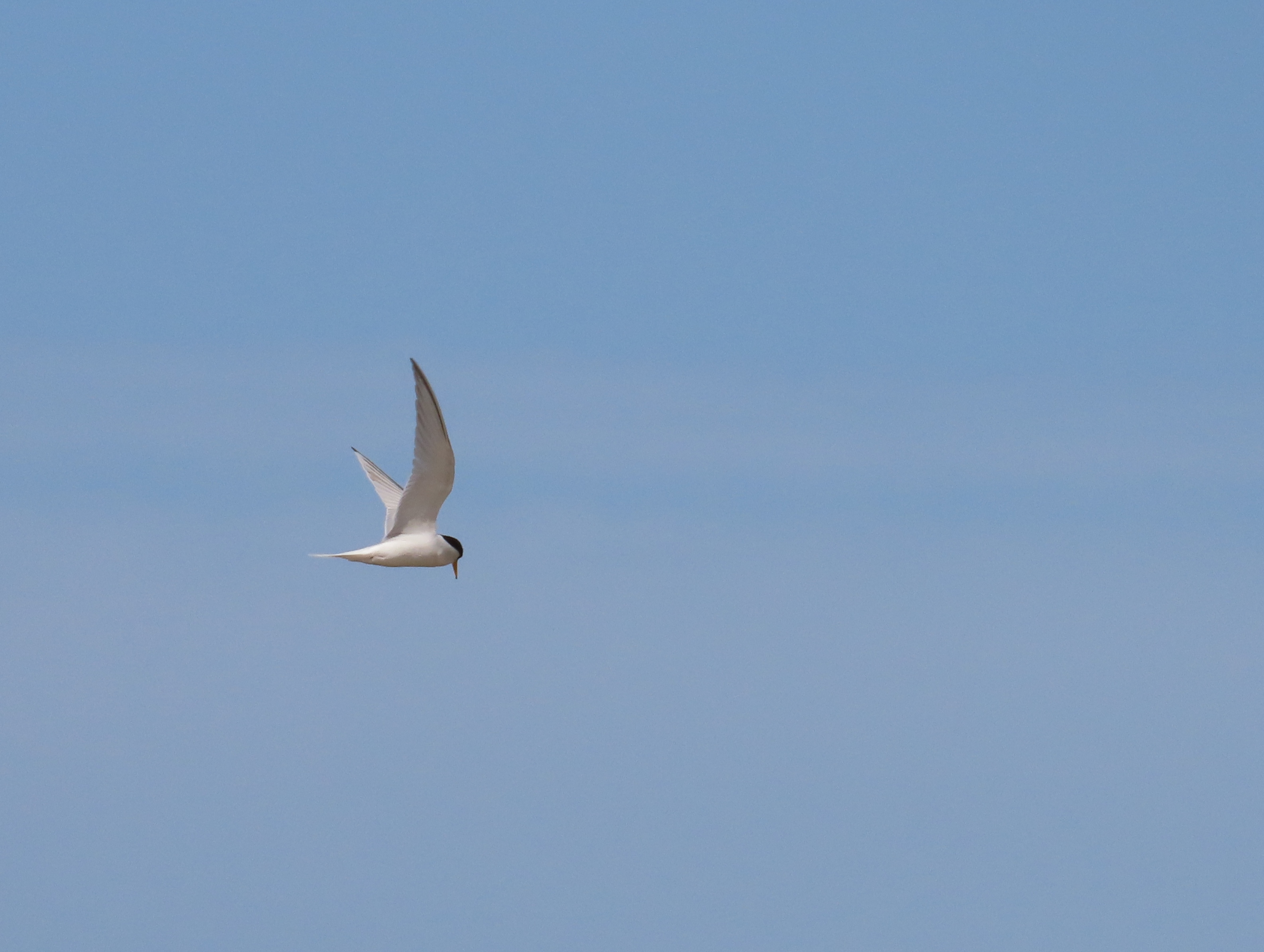

LITTLE TERNS were flying offshore

Inevitably I had to come back home to civilisation and as I came closer to Wells the beach gradually became busier, until it became so crowded with the beach huts, the deck chairs, the parasols, all the detritus of beach resorts. Hundreds of holiday makers all crammed into a small area of beach and there's me walking around with a telescope and binoculars, looking out of place. Coming to North Norfolk to view the wildlife, and to find somewhere quiet, I often forget the other side, the tourist side, where the non wildlife experience is. This is what normal people look for.


Beach huts on Wells beach

A very quiet day down at Holkham, but enjoyable non the less. Its good to explore all these lands, even if I don't see much. A place like Holkham has so many jewels, yet they are much harder to find than the other reserves. Its a place that doesn't open itself up like other places like Titchwell where things aren't handed to you on a plate, so calls for a more rugged birdwatcher, one that doesn't mind putting in the effort to find those good, good, birds. As always people have different ways of viewing birds, so its nice to experience all these different places, and its god to know there are such good places for birds still remaining in this country.

Tuesday, 24 May 2022

Titchwell - 13/5/2022

GODWIT (c) with two AVOCET (l&r)

Although a big beast of a reserve in itself, Titchwell just can't match Minsmere when it comes to bird spectacle. The Freshwater Marsh at Titchwell although similar in habitat to Minsmere's Scrape just doesn't match up with the number of birds. Titchwell is so much quieter, less visceral then Minsmere. But saying that Ticthwell is still a good reserve in its own right, still a good birding destination, just not quite as good as Minsmere. This was my first stop on a week's holiday in North Norfolk, so expect plenty of posts about the other reserves I went to as well.


Family of GREYLAGS. Huge numbers of these geese nest in the various waterways throughout the country.

The Freshwater Marsh is the main focal point to the reserve, a large body of water with several islands, that proves attractive to birds. New islands had been created last year in the Autumn, so its good these new islands are being used by breeding birds this year. AVOCETS, GULLS, and COMMON TERNS were nesting in decent numbers on these islands, little white spots dotted around the brown land. Of interest was a LITTLE GULL, among some godwits, not quite in its summer plumage, with a tatty head. As its name suggests its the world's smallest gull, roughly the size of a tern, much smaller than the other gulls around. Several LITTLE TERNS had arrived back to Titchwell, and again like the little gull these are our smallest tern, with a nice yellow and black bill. The birds have the unfortunate habit of nesting on our beaches, which in summer are overrun with people causing great disturbance. As a result the birds are finding it difficult to raise families in this busy land, and are much rarer than they need to be.


LITTLE RINGED PLOVER. To tell it apart from a common ringed plover, the LRP has yellow legs, a more subdued brown back and that huge yellow eye.

The Freshwater Marsh is very attractive to WADERS, and being  the tail end of Spring they were some still migrating, the last of the birds heading north towards their breeding grounds. At this time of year the waders are in attractive breeding plumage, shedding the browns and greys of winter, for reds and blacks. There were around ten or so DUNLIN and TURNSTONE about, both with nice plumages. Slightly more dowdy and browner in plumage, was a single LITTLE RINGED PLOVER and COMMON SANDPIPER.


A herd of BRENT GEESE were still lingering

Faint lingering memories of winter were still lurking around the reserve with a herd of roughly a hundred BRENT GEESE, in various parts of the reserve. Charcoal in colour, brents are our smallest goose, smaller than a mallard. They nest right up above the Arctic Circle, so has to leave their wintering grounds as late as possible, to get the right conditions, so some still hang around even this late. As is usual at this time of year there were small numbers of breeding DUCK about, with GADWALL, SHOVELLER and POCHARD, around the various pools.


SANDERLING were present in small numbers on the beach

Usually the beach and sea are of interest at Titchwell, but that's usually in winter. Today, in May, there were small scattered flocks of SANDERLING, some in their purply summer plumage, some in their white winter. They run around like clock work toys on the water's edge. Two summer plumaged GREY PLOVER flew down the coast, but apart from that there was only the odd gull or tern flying lazily up and down the coast.


A one legged male POCHARD

Returning back from the coast, I had a look around the reedbeds and Patsy's Pool. The most obvious bird, one I couldn't escape, was a very loud CUCKOO calling from the reedbeds. Its constant calling out over the reeds seemed to be mocking me as I looked for the bird in vain. If a cuckoo is calling, then its not moving, so you have to wait for it to be quiet to catch a look. Eventually I did see the bird, speeding off over the Freshwater Marsh. In flight it a dark bird, with pointed wings and long tail, it looks like a bird of prey more than anything.


Island Hide which overlooks Freshwater Marsh

With Spring migration gradually grinding to a halt, it led to a fairly quiet day's birding at Titchwell. A few late waders was all to show really as well as the usual breeding birds. I don't usually come to North Norfolk at this time of year, because its fairly quiet. However with an area like this, anything could turn up anywhere, so things never get boring. As always its the unpredictability of this hobby which keeps me going and coming back for more.

Saturday, 21 May 2022

Brancaster - 13-20/5/2022

The BARN OWL perched briefly for my benefit

North Norfolk is a place like no other for the birdwatcher, an incredible landscape which stretches over miles of countryside, attracting birds, rare and common, in great quantity. So it was not a hard decision to take some time off and to move over the border for a week's holiday in mid May. And it did provide some good bird watching as I visited all the big reserves on the coast and saw some cracking birds.


BARN OWL in flight over the marshes

Over the course of the holiday I stayed in a rented cottage in Brancaster, on the western side of the coast, just a bit along from Titchwell. Its a nice place, I guess, sort of like every village on the coast, but that's not what is of interest to you or me, we only care about the wildlife. So, the countryside around Brancaster was very interesting, a bit off the birdwatching beaten track, but nice and wild.


DUNNOCK

This is a part of the North Norfolk Coast I know nothing about, except as a place to drive through on the way to and from some nature reserve, usually Titchwell. The surrounding countryside is quite interesting, but its not really comparable to the big reserves found in other places on the Coast. The area is managed by the National Trust, and really, they are doing a good job, as the area was in good condition. I did a lot of walking around this site and explored quite a wide area over several days, usually around visits to other reserves.


GREAT SPOTTED WOODPECKER on a telegraph pole

Towards the back of a large stretch of saltmarsh, reedbeds had developed and in one area, aside from all the commoner WARBLERS of the reeds, a GRASSHOPPER WARBLER was singing. Technically their song is called "reeling" as it sounds like a fishing rod reeling, a song of one note continuously emitted for brief periods. This is a reedbed bird that has become hard to find, strangely at a time when every other reedbed bird is increasing, its disappearing from places where it used to be common, so was a good bird to catch up on.


Female REED BUNTING

In an early morning walk, in a clearance in the reeds, I encountered a BARN OWL, briefly. There are mythical birds, ones that everyone has heard of, those that no matter how experienced a bird watcher you are always chuffed to see. And BARNIES are one of those birds. I saw it briefly on my first exploration at six in the morning, and venturing out for a second day at this time, just to see it again, I saw it perched on a fence post, but again, oh so briefly before flying off, the white phantom of the marshes.


Creek running through the saltmarsh which develops behind the dunes

On the 15/5 I walked all round the whole site, exploring the varied landscape of the area. Towards the sea, the habitat turns to a prestigious golf course behind the dunes. Having explored this area and walking further, I came across some nice wet grassland, grazed to different swards, and holding large dykes and pools and was good for DUCKS, like GADWALL, POCHARD and SHOVELLER. A SPOONBILL flew over and a CUCKOO was heard calling across the grassland, all good birds of the marshlands.


KITE SURFER
.

In an area like North Norfolk even the more low key areas are rich in birdlife. Its often good, for a birdwatcher, to look at those areas on a map, which look like they might harbour birds, but aren't nature reserves, and just go explore them. Sometimes it works, sometimes it doesn't, as you don't know what you will see. Sometimes its just good to get away from the established reserves to find something of your own for a change.


Friday, 20 May 2022

Snape Marshes - 12/5/2022

When I first visited Snape may years ago, what are now the marshes were closely grazed dry grassland, offering little of interest for the birdwatcher. Then one year Suffolk Wildlife Trust bought up the land and with careful management turned the area into a haven for wetland birds. A mixture of sward heights, from close cropped grass, to tussocky sedge, to dense reedbed, along with added pools and ditches has given the area a new life.

As early summer dawns on the marshes, there were plenty of birds about. Nicest find was a REDSHANK chick feed on the edge of one of the pools, with a very nervy parent piping nearby. The  chicks are often hard to see as redshanks enjoy the longer grass for shelter. There were around three more pairs about, but their fortunes were unknown to me as the birds hide their young away. At least five pairs of LAPWING were about, some sitting on eggs, others on the move, although I didn't see any chicks, there probably were some about as they tend keep to cover. Finally a pair of OYSTERCATCHER completed the triumvirate of waders in the area. Also on the Marshes were a pair of EGYPTIAN GEESE, some GADWALL and a male MARSH HARRIER flew over. 

On the other side of the sea wall to the Marshes, it was mid tide on the river Ore estuary, and being Mid May, the number of  WADERS were low. However there was a good variety with three WHIMBREL, two GREENSHANK and five AVOCET feeding on the exposed, gloopy mud. There were also lots of SHELDUCK about, all forming pairs, they will nest around the estuary when they get the chance, they tend to raise large broods of grey, stripy ducklings.

There you go, this was a quick visit to a place I know fairly well, but was surprised just by how much has changed. Snape Marshes have increased so much nature wise and the responsibility for this rests with the Suffolk Wildlife Trust. Our conservation charities do so much good work, looking after our most precious wildlife, on such a tight budget. However land given over to wildlife is miniscule, Snape Marshes are such a tiny part of our countryside, a pin prick really, lost within a sea of dead, industrialised farming. The  only way to help nature now is to turn over our land to wildlife, those corners of our countryside, which contribute nothing to food growing but can benefit nature.

Tuesday, 10 May 2022

Minsmere - 5/5/2022

A little GREYLAG gosling with its mum

The one thing about birdwatching is that it should be done away from people. It should be savoured as something alone, something personal beyond the fetid stench of civilisation. It feels so good to breathe in that clean air, to hear nothing but the faint sound of birdsong. So it was today that when I entered the car park at Minsmere, that my heart sank: two coaches and a car park full of cars. These are the people that pack out the hides, scare that bird you patiently waited to photograph, and just in general remind you that there is a human world there waiting for you to come back.


AVOCET nest on the Scrape in large numbers

Ok so I may be a grumpy birdwatcher, and I exaggerate, I don't really think as badly as that, but sometimes I need birds to help me get through the world, to escape it. I need to immerse myself into the natural world to clean my soul which had been so dirtied by the human world. But in the end it didn't amount to anything as apart from the packed hides, where it was a bit tricky to get a decent view, people were at a minimum. The countryside is good for thinning out the crowd.


At this time of year TURNSTONE look very dapper, when compared to the grey and browns of winter plumage

So misanthropic whining done, what about the birds? As always with Minsmere there were plenty of birds, and more so for being Spring, when the birds are at their most active. Birds are singing, nesting and on the move, creating a heady mixture of unusual birds. Spring is the time of year when you look for the firsts of the year, when you encounter a bird for the first time, a bird recently arrived from its wintering grounds, and welcomed back. In early May I was still looking for a few new birds, as the later birds start to turn up and catch up with those that had already arrived.


REDSHANK nest on the Scrape in large numbers, although they don't look like much, they have an evocative, haunting call which gives them the alternative name SENTINAL OF THE MARSHES

As always the centrepiece of the reserve is the Scrape, a large area of shallow water with a scattering of islands, which is very attractive to birds. At this time of year interest is concentrated on migrant WADERS, as birds move north to their breeding grounds and pass through Minsmere. May is when they are in their summer plumage, brightly coloured, unlike their winter greys and whites, making them very attractive. Although there was a few birds about there was nothing out of the ordinary, the usual birds to expect in early May. Three REEVES, female RUFFS, were on West Scrape, but unlike the males, which are so extravagantly attired, the females look a bit like redshanks, fairly non-descript. Three BAR TAILED GODWIT were on South Scrape, draped in brick red, as well as ten DUNLIN, with their black bellies, and three beautiful TURNSTONE (see photo). A COMMON SANDPIPER was present around the Scrape, a little brown job, not as attractive as the other birds.


Nesting BLACK HEADED GULL. This is the species which nest in the largest number on the Scrape, with maybe a thousand pairs, their constant squabbling gives the Scrape a very evocative sound.

BLACK HEADED GULLS are the main breeding birds of the Scrape, which normally nests here in the thousands. However there weren't so many this year, and only a couple of pairs of MED GULLS were present on South Scrape, where over the last couple of years there were nearly a hundred present. For some reason there were hundreds of COMMON GULLS hanging around, no adults, just first and second winters, a strange record for this time of year. Despite their name they are not the most commonest gull at Minsmere, usually present in small numbers in winter. A few KITTWAKES were about, this is the true sea gull, they nest further down the coast at Sizewell, on the off shore platforms. A few COMMON TERN were about, but numbers were low, although more may turn up as they nest later in the year. A flock of around fifty or so SANDWICH TERNS were on South Scrape, this large tern occasionally nests here but flocks build up in Spring before heading off to other breeding grounds.


Pair of GADWALL with a BLACK HEADED GULL. This understated duck likes the -- of the Scraep to nest in.

A feature of the Scrape at this time of year is the gaggle of  baby geese that congregate here in large numbers. Both CANADA and GREYLAG goslings were in force, crèches of little downy yellow birds attended by their parents, there were just loads and loads of them. Although so many birds are declining, GEESE numbers are increasing exponentially, and anywhere there's water you can find them. Lots of BARNACLES were about, but hadn't started nesting yet. DUCK numbers were much lower than previous visits, obviously, as birds reduce to start breeding, in smaller numbers than winter. Plenty of the commoner birds, like GADWALL and SHOVELLER were about, whilst there were still good numbers of TEAL about, and a pair of WIGEON on South Scrape.


 A gaggle of CANADA GOSLINGS

A nice first of the year, for me, were two HOBBIES behind Island Mere, a bird of prey that catches dragonflies and other large insects in the air over the reeds, a bird that has to arrive later to coincide with their prey. They look swift like with sharp wings, flying dynamically through the air in search of their prey. A first for me for Minsmere was a nice RED KITE over the woodlands near Whin Hill, a bird that has taken its time to colonise Suffolk, despite being common in the rest of the country. They are distinguished by their forked tail, and their bent red and white wings. Of course there were lots of MARSH HARRIERS about, a bird of the reedbeds, one of the many rare birds Minsmere is important for. A GLOSSY IBIS has been present since March, and was found in its usual place in the Konik Fields, partly hidden in the marestail, its plumage made dull by the poor light.


A Marauding COOT

Its not often that I have to wait until May to see my first SAND MARTIN of the year, Usually I would have caught them arriving in late March, early April, but not this year. With what seems like a population crash, no birds had turned up at their usual haunts, and it was only today that I was finally able to catch up with the bird. They seem to be nesting this year, unlike the last, digging holes in the sandy cliff that forms the old car park. At this time of year small birds are at their most active, constantly in song with the early nesters raising young. As you would expect the reeds were full of REED WARBLERS, SEDGE WARBLERS, CETTI'S WARBLERS and REED BUNTINGS, a cacophony of many different songs providing a nice backdrop to my walk. A BEARDED TIT was briefly seen from North Wall, whilst more were heard at Island Mere and in the reeds between South and West Hides, pretty little ginger birds, iconic birds of the reed beds.


The GORSE stretches for miles along the Dunes, the whiff of coconuts carries on the wind

The gorse along the Dunes, were out in yellow flower, disgorging the scent of coconuts, and the thick cover they provide is great for birds. LINNETS, DUNNOCKS and WRENS were all seen and two pairs of STONECHAT were about, a bird you can encounter throughout the year, they have the nice habit of perching atop a perch, providing good views of a gorgeous bird. Migrant wise A LESSER WHITETHROAT was in the Sluice Bushes, another first for the year.


Huge numbers of GULLS congregate on the Scrape

Wow, with so much to write about its been a massive effort creating this blog. The sheer quantity of birds that reside in Minsmere is just mind blowing, and to describe them all would need more than a few paragraphs and ten photos. Every tree, every bush, seems to hold birds at this time of year, and with the range of habitats at Minsmere, attracted such diversity. I have not mentioned a lot of the commoner birds, those I encountered everywhere, those overlooked birds we take for granted here, but anywhere other than Minsmere, would get a mention. As I usually say, places like Minsmere are so special, so important for our wildlife, and for once is a place so well looked after.

Thursday, 5 May 2022

The Gipping Valley Lakes - 30/4/2022

WHITETHROAT

What a beautiful day it was to take a walk along the river Gipping, to do some birdwatching in a quiet and underwatched area. The sun was out and people were few and far between, as were the birds. Although I didn't see much, it was such a great day to do some birding, a way to appease the soul as only nature does. I walked from my house in Whitton, down the traffic free Old Norwich Road, to Claydon where I made contact with the river Gipping and then made my way up the river to Baylham, passing along several flooded pits along the way. The usual breeding birds were about, but what was shocking was the lack of any hirundines, swallows and martins, birds I would usually see in large flocks at this time of year. Their population seems to have crashed this year, I saw a flock of five SWALLOWS and two further individuals, a paltry amount for some usually common birds at this time of year.


GREAT CRESTED GREBE among the bulrushes

My house exists on the edge of Ipswich and its a short walk to Old Norwich Road, which takes me right into the countryside. Traffic is purposefully restricted here, so its an idyllic area of walkers, cyclists and horse riders, not having to worry about getting run over. Along this road it was a forty minute walk to Claydon, with plenty of birds in the road side hedgerows, warblers like WHITETHROATS stood out, their scratchy song issuing from a tall bush.


Male REED BUNTING. This species is very obliging for photography as it has the tendency to sit on an exposed point.

In Claydon I caught the river Gipping and came to Barham Pits. A series of fishing lakes, created to make the bordering A14, they look natural enough, being bordered by trees. However they are pretty lousy for birds, with just the usual gravel pit birds present in small numbers. Its best not to have high expectations of seeing something rare, as you would be very disappointed.

Barham Pits

The first pit is Barham Pit B, the largest lake on the Gipping, a long thin lake bordered between the river and the A14 . Its attractive to breeding birds found in this type of lake, common birds found anywhere there is plenty of water. Two pairs of GREAT CRESTED GREBE were about, both with broods of two chicks, although one was very old, close to fledging, so possibly had been born over winter! A SWAN was nesting, and within the large number of GEESE there was a GREYLAG brood of six. Four COOT were about and a flock of nineteen TUFTED DUCK, the largest number I've seen on this pit, although they will be passing through, and probably wont breed.


Being close to the A14 the area was very industrialised with many depots and factories about

Barham Pit A is much smaller, and the new owners have destroyed a lot of habitats, like the fringing reeds, creating a soulless area of water. As a result only a pair of CANADA GEESE, GREAT CRESTED GREBE and COOT were about. The most northerly lake, Meadlands Pit held nothing.


Nesting SWAN Barham Pit B

From Barham Pits it was a short walk to the middle pits along the river. Although Barham was quite urbanised being next to the A14, the river soon moved into areas of countryside, areas of cow pasture, outside any village. Where the river slows down, reeds grow within its stretches, providing home for REED WARBLERS and REED BUNTINGS.  Not particularly close to a public car park, the small middle lakes are very much underwatched. Causeway Lake is fished, although no as much as Barham, but Shamford Mere is pretty quiet human wise.

Causeway Lake and Shamford Mere

Fairly quiet, Causeway Lake Held two pairs of SWAN, a pair of GREAT CRESTED GREBE, a whooping GREYLAG brood of ten, and a COOT brood of five, with four further birds about.


Along the Gipping by the middle lakes, the Suffolk Wildlife Trust had planted a number of trees along its stretch

Shamford Mere held a few more birds. A pair of GREAT  CRESTED GREBE, a pair of SWAN, and a CANANDA GOOSE brood of five. Possible breeding birds were a pair of GADWALL, ten TUFTED DUCK, and a single EGYPTIAN GOOSE, birds which may be passing through or not. A GREY WAGTAIL was about, and a KINGFISHER whizzed by too fast to appreciate its beautiful plumage.


CANADA GEESE with goslings

From here I took the river path to Baylahm Rare Breeds Farm and out on the main road to catch the bus home.


The lock on the river near Causeway Lake, a human made barrier on the river

In a quiet underwatched area, off the beaten track where few people go, the lakes of the river Gipping are a great way to get away from it all in a fairly urbanised area. Although I go to Barham Pits quite regularly, as its only a short bike journey away, I can't remember the last time I went to the middle pits, maybe over a year ago, so it was nice to have a look. It may be another year before I go back again, and although I may not see anything interesting again, it doesn't matter as I'll still have a pleasant time as I always do birdwatching.

Tuesday, 3 May 2022

Belstead Brook - 28/4/2022


Even in a country as barren for wildlife as the UK, there are still some wildlife spectacles to be witnessed, and one of them is the drifts of BLUEBELLS that extend under our ancient woodlands. The couple of weeks which extend over late April and early May is the pinnacle time for which to come and see this little spectacle. In Ipswich the best place to see bluebells is Spring Wood, to the south of Chantry, bordering the A14. This wood forms part of the Belstead Brook series of nature reserves, a small river that flows through small reserves like Ashground Plantation, Bobbit's Lane meadow, and Bourne Reedbeds, places which I also visited today. This is a wild area of Ipswich, where you can get away from the houses and people that is the usual habitat and wildlife of this town.


Before I get to the bluebells, another sighting was the standout of the day, something quite different to the flowers. An OTTER, yes an OTTER, was seen today, the animal emerging from the brook, running across the path in front of me and disappearing into the thick undergrowth in the fraction of a second, a blink and you miss it event. Obviously this is my first record for Ipswich, and just shows how wild the area can be despite being on the edge of a large town. This was in Ashground Plantation, an area of alder carr which floods in winter from the brook which flows through. Also on the edge of the car park there a BAT was flying in broad daylight, a very strange sight indeed, of what species I don't know, the only way to tell them apart in flight is to use echolocation device things.


As usual the BLUEBELLS under Spring Wood put on an awesome display. Under the coppice carpets of blue unfolded before me. Spring Wood is an Ancient forest that has been in existence since records began, and for a town as old as Ipswich, its pretty old. Although it looks beautiful, the woods are not peaceful, being right next to the A14, Suffolk's busiest road, it suffers from the heavy din of traffic. Also here were some YELLOW ARCHANGEL, another ancient woodland flower, although just the odd flower, not in the numbers of the bluebells. I didn't take my DSLR camera, instead I used my Bridge Camera, and it really shows, when compared to the photos I took at Bradfield Woods, a previous post ago.


YELLOW ARCHANGEL

Spring Wood is buffered with the housing estates by Kiln Meadow, an are of scrubby grassland, which is attractive to birds. WARBLERS abound, with my first GARDEN WARBLER of the year, singing from an area of scrub, as well as lots of WHITETHROAT and BLACKCAP, and a cracking male BULLFINCH. In an area of mown grass COWSLIPS were growing in small numbers.


Coppice stools in Spring Wood

Bourne Reedbeds are a large stand of reeds, maybe the largest in south Suffolk, and like the rest of the area, a strange habitat to be found in Ipswich, something you would expect from a wilderness like Minsmere. Its just shows that nature can survive pretty much anywhere, its not too fussy, it just needs the right habitats and to be left alone. Here I heard my first REED WARBLERS of the year, their monotonous song competing with the more energetic SEDGE WARBLER and the explosive CETTI'S which were singing in small numbers, birds heard rather than seen.


Who would have thought there would be so much wildness in the town of Ipswich, a barren area of anonymous housing estates. Sure the wilderness exists on the edge of this town, but it still lies within sight of the housing estates that fill the town. It shows that nature can thrive anywhere, if we just let it, and that also some of our best remaining habitats exist in areas where they are under pressure, whether from the need to build houses, or nuclear power plants. No matter where the land lies, everything of worth to wildlife needs to be protected.