Friday, 15 September 2017

Lakenheath Fen - 14/9/2017


LONG HORNED CATTLE grazing on the river bank

We took a little trip over to West Suffolk to see the two best bird reserves over there - Lakenheath Fen and Lackford Lakes. First off is Lakenheath, the fenland created from a carrot field.
Lakenheath is an enigma of a reserve. It is an amazing place, an inspirational one in fact, by bringing back to the fens what was once lost. But it is also a frustrating place to birdwatch. There might be loads present but the birds are so difficult to see.
I remember the first day I visited Lakenheath, it was a stormy October's day and I saw nothing. I have only ever been irregularly since, and not for about a year and a half. Today didn't seem too promising, it again being very windy and nothing seen from the visitor's centre.
I was showing my brother around as he was new to here, so it was quite good to show him the grand scale of the reserve - it is absolutely enormous.
Several HOBBIES and KESTRELS were seen over the New Fen providing an identifications challenge. Over to the Mere Hide, and someone had spotted a WATER RAIL, which was present showing only a red bill and a bit of head through the reeds. It took great observational powers to find that. Two BEARDED TITS flew round the back of the reeds and several were heard on the way to Joist Fen.
Unfortunately the Joist Fen watchpoint had management work being taken out in front of it. As a result from the burning of the cut reeds literally nothing could be seen through the smoke. Essential, but a bit annoying.

Management taking place at Joist Fen. My camera couldn't take the smoke
 

We walked back along the river, but didn't see much until we got opposite the Washlands which was full of ducks, mainly GADWALL, SHOVELLER and TEAL. A GARGANEY had been reported present but I didn't feel like sorting through all those ducks to find it.

Washlands
 
So we didn't see much and it at times felt very frustrating when the place is so close to being a great reserve. As it's not quite on my birding radar it will probably be sometime before I come back. 

Thursday, 7 September 2017

OTTERS crown a fine day - Minsmere - 7/9/2017

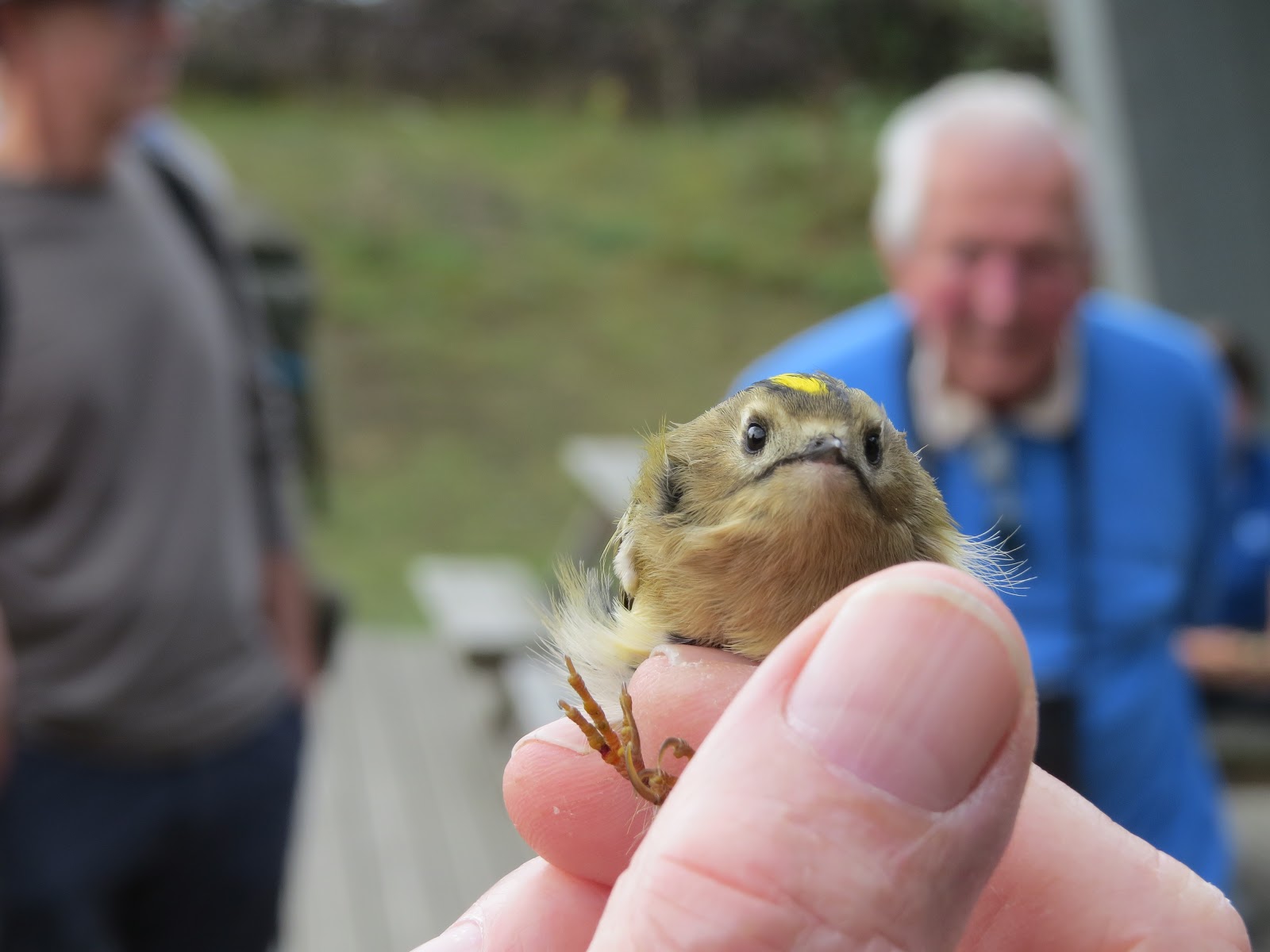
There was a bird ringing event and I was able to see this GOLDCREST
 
My brother was staying in Suffolk for a while, so where better than to take him, than the best nature reserve in the country - Minsmere. It was a warm cloudless day upon arriving, and it would prove to be keep it up all day, the warm sun keeping Autumn at bay. It being Minsmere there was plenty about, it was a decent mid Autumn day.
The highlight of the day was the three OTTERS at Island Mere hide. They were first spotted briefly in the small pond to the south of the hide, before moving out onto the mere proper. It looked as if there was a female and two old pups. They seemed oblivious to being watched and they were very active, constantly playing with each other, seeing their heads above the water and their whip like tail.
Apart from and maybe because of the OTTERS, there wasn't anything on the mere apart from a few SWANS.

OTTER briefly surfaced
 

As usual for this time of year, attention was directed at the Scrape, and the migrant waders upon it. The Scrape at this time of year is fairly quiet, with just a few waders and ducks. Wader numbers and variety were fairly normal for this time of year, numbers gently falling after reaching their peak. On East Scrape there were six SPOTTED REDSHANK, 2 RUFF, one KNOT, two DUNLIN, 22 AVOCETS and three SNIPE. On West Scrape, overgrown with marestail, were two GREEN SANDPIPERS, around 10 SNIPE, five RINGED PLOVER, two SPOTTED REDSHANK, and around 20 DUNLIN. A few WIGEON had returned and were amongst the resident duck species. South Scrape however was completely deserted.


There were a few migrant passerines present in the bushes across the reserve. Around ten STONECHATS and one WHEATEAR were present in the Dunes, often perched silhouetted against the sky on some gorse branch. WARBLERS included LESSER WHITETHROAT, COMMON WHITETHROAT and WILLOW WARBLER skulking in some bush or other. There was a small flock of BEARDED TITS beside East Hide, and their 'pinging' call could be heard ghost like across the reedbeds. A KINGFISHER flew across the Dunes, passed the Sluice and onto the marshes. This is probably only my second sighting of this bird at Minsmere.
DEER were represented by a CHINESE WATER DEER grazing at the back of one of the Konik Fields and a stag RED DEER on the way from Island Mere Hide.


HIGHLAND COWS and KONIK PONIES, were being used to graze the Scrape directly in front of the North Hide, getting it ready for the winter.

This brute had huge horns
 
So although there weren't any rarities about, or nothing particularly unusual like you hope for September, it was one of those days that are decent anyway, and provide pay back for the effort put in to this great hobby.

Tuesday, 29 August 2017

A Muggy Day Down at Trimley - 29/8/2017

It being the end of August, and with Autumn reaching its heights I decided to take a trip down to Trimley in the chance of maybe encountering a migrant wader or two. The day, although not particularly sunny, was very hot and muggy, and I was sweating buckets. When I got to Trimley Marshes, it was quite shocking to find a lot of the reserve dried out, and pretty bird less.

Looking to the docks over the Managed Retreat
 
The long walk down to the reserve provided little except for one STOAT that dashed across my path. The approach track was pretty busy with construction traffic, which often meant getting out of the way of trucks loaded up with stuff. They were busy constructing something near to the reserve.
The first stop at the Reservoir provided the usual mix of COOT, GADWALL, TUFTED DUCKS and GREYLAGS, all congregating as a mass of birds in the middle of the reservoir. New about was a family party of LITTLE GREBE.

GREAT CRESTED GREBE having a shake
 
Immediately in front of the hide is an area of reedbed on either side of the view onto the reservoir. Two BEARDED TITS flew across, providing brief views as they "pinged". They were juvs, so maybe they have nested on the reserve this year. Anyway it was a site tick for me, and for the numbers of species seen Trimley may now be my second best site, but still some way behind Minsmere, which is first.
The new scrape behind the Reservoir hide had dried out and was now being grazed by cows. Other areas of the grassland had been mowed, providing different habitat types.
So it was on to the scrape hides, and expectations were high as Trimley is often good for waders. However, both the Permanent Lagoon and the Summer Flood were completely dried out. Considering all the water in the Reservoir, it seems strange they didn't try to  keep  these scrapes wet. I don't really know the mechanics of water management, but some water could have been maintained.
The Winter Flood still had a little bit of water, and crucially wet mud, and so attracted a few waders. Two GREEN SANDPIPERS, four SNIPE and one COMMON SNADPIPER were present, amongst the LAPWING and GODWIT.
On the river the tide was coming in, leaving some mud exposed. The most common waders were GODWITS, with small numbers of GREENSHANK, REDSHANK and OYSTERCATCHER.
 
 
SWAN with GODWITS
 

By the Managed Retreat there was a SEAL briefly putting in a performance before drifting up river.
 
SEAL
 

Finally, Loompit Lake held just a few GADWALL and TUFTED DUCK, with no COOT present.
The walk back, through farmland, held a large flock of nearly 100 GOLDFINCHES feeding in a thistle bestrode area of set-aside.
As I walked back through Trimley a female SPARROWHAWK dashed across the road, disappearing behind another house.
So, although I didn't get what I had primarily looked for, migrant waders, the day was fairly eventful, and I can't really expect more on a hot muggy August day. September is coming soon and I have a few trips planned for that month. As always I'll keep you posted.


Thursday, 24 August 2017

Migrants Drifting Through - 24/8/2017

Today I did an early morning route of my local patch. Now I've probably never described this place before, chiefly because I don't really see much there, but it is the area where I bird watch the most. Its an area of farmland which starts literally two streets away, an area that is easily accessible. This is a place where I can be with nature without any effort.
The area has a variety of farming habitats, like arable land, hedgerows and meadows, but due to a lack of woodland and water habitats it is fairly limited in what is seen there. Good populations of farming birds are present chiefly YELLOWHAMMER, LINNET and SKYLARK, birds which are declining in the countryside.
Today there were a few migrants about. An area of cattle grazed grassland, with scattered bushes, acts as an occasional migrant trap, and today there were six or seven LESSER WHITETHROATS about, some CHIFFCHAFFS, and a female BLACKCAP.
On one of the large arable fields, the farmer has allowed the field to go fallow after cutting, resulting in large numbers of "weeds" sprouting up there, which in turn  attracted a large flock of 30+ LINNETS, with a pair of BULLFINCHES also present, there melancholy call so very distinctive.
I don't know if there's much about in the wider countryside but at this time of year anything's possible so keep birding.

Tuesday, 22 August 2017

OTTER at Barham Pits - 22/8/2017


I thought abut going to Trimley today, but couldn't be bothered to go through all the hassle of getting there, so I went local and visited Barham Pits. Expectations were not high, as this site is pretty rubbish, because although it looks picturesque and wild, it is intensively managed as fishing lakes.
So it came as a surprise to come across an OTTER there, on part of Pit B. It was very wary and I only saw it a couple of times, as it didn't come up too often and I wasn't able to take any photos. It was well aware of me, occasionally popping its head up to peep at me.
Although the pits would appear to be OTTER heaven, with all the fish there, it had also entered the viper's pit. This is one of the few areas in the countryside where OTTERS are not welcome. I doubt these fisher men, who own and manage the pits, have a sympathetic view of nature, and I think would have little compunction in killing an OTTER. If there are no witnesses no one reports them. I hope the OTTER hides away, and then escapes into the night, without coming to any harm. But I doubt it will - its fate looks bleak.


There were few water birds about. A COOT family had raised three chicks on Meadowlands pit, whilst the other pair on Pit A didn't raise any. On Meadowlands there was another GREBE chick, with one also on Pit B, so I think maybe five birds have been fledged across the pits. There were a pair of SWANS on Pit B but they didn't nest this year.


Being a messy, overgrown wetland area, there are lots of small birds. A large flock of birds, mainly TITS and CHIFFCHAFFS, also included some GOLDCRESTS, and a TREECREEPER. A GREY WAGTAIL flew over and there were several KINGFISHER about, very noisy birds when you learn their call. There were lots of WOODPECKERS, with several moving through the site, always such pretty birds.
So alright then, always good to see an OTTER, but apart from that not much else. From the for sale signs around, it seems the site has come up for sale, so maybe a chance to buy it up and create some wildlife refuges or a chance it becomes worse.

Tuesday, 15 August 2017

At Least it Stayed Sunny - River Gipping Pits - 15/8/2017

Carrying on a rather duff August I walked the short journey from Baylahm to Needham Market, following the river Gipping and calling on several pits as I went along. The day was sunny, but not too hot, there was a very fine wispy cloud over the sky.
The first pit I called on was at Pipp's Ford, a mix of finished and ongoing gravel extraction. The finished pit was mainly dried up, strangely considering the fact that it has been a fairly wet August. So there was only a few GEESE, and a handful of LAPWING.


 The ongoing extraction pit was all flooded, but there was little about except some loafing GULLS. A large flock of 50 GOLDFINCES was present, probably a collection of local breeders and there was some GREY WAGTAILS about.


Heading north, Pippin's Lake was empty, while the pair of SWANS at Riverside Farm Pit seemed to have lost their young. There was work on the pit that looked to be extending the lake, which is good as it is quite small, maybe about half an acre.


Alderson Lake, heavily fished, held another pair of SWANS without any young and there was also a KINGFISHER. Needham Lake was just too busy with people to do any birding. It was quite a shock arriving from the quiet countryside to this busy little local nature reserve, on the edge of Needham Market, with scores of people picnicking, cycling and walking the dog. Oh well, can't complain because it means people getting closer to nature, something which is good.
So a fairly unproductive day, one where the amount of effort put in didn't correspond with what I took out, such is the enjoyment of bird watching. I think I'll need to go somewhere "big", a reserve created for birds, somewhere it is guaranteed that I'll see lots of them. I shall have to determine where.

Thursday, 10 August 2017

Birdwatching memories - Minsmere - May 1993

I was eleven years old when I first visited the hallowed grounds of Minsmere. I was on a caravan trip with my family, to Suffolk, staying at the site just out of Dunwich Heath, on the borders of Minsmere. I came from the inland of the country, near Tring Reservoirs and had never bird watched on the coast.
Back then Minsmere had a different visitors centre, and car park where the pond and sand martin colony are now. The first experience was really reaching the hide that overlooked  the scrape. I remember opening up the flaps to the hide window and looking out upon the scrape to see my first avocet. I nonchalantly told my brother 'there's an avocet', hoping not to sound to other people in the hide that this was important, whilst  secretly inside my heart was beating fast - this was the most iconic birds in this country and this is the first one I've ever seen. Well there wasn't just one, there were hundreds.
This distinctive and totally original bird, beautiful in its extremes with its plumage of white and black, with it beak bent up at the end, of its habitat, of what is really a large pond with islands. This moment was my introduction to being a full birdwatcher.
I have been to Minsmere many times since, so many that most of my memories have become embedded in the landscape, and I can revisit them any time I return to Minsmere. I also have seen many avocets, but that is probably still the best moment that exists in my memory, the very first time. There were other things that have changed since then in bird watching -  the waxing and waning of different bird populations, and also my own skills as a birdwatcher, but I can still revisit the place it all began.